SaaS Billing Best Practices: Models, Metrics, and Tools in 2026
SaaS billing is the part of running a software business that quietly determines whether the rest of the business works. The pricing model controls who buys; the billing system controls whether they pay reliably; the revenue recognition controls how the finance team books what gets paid. All three are decisions you make early and pay the cost of changing later.

This guide covers the four SaaS billing models in common use in 2026, the metrics that matter, what to look for in billing software, the basics of revenue recognition, and the new wrinkles that AI and API products introduced over the last 18 months.
What SaaS billing actually covers
SaaS billing is shorthand for a stack of related capabilities:
- Pricing model. What the customer pays for and how the price scales with usage.
- Subscription management. Who is on which plan, when their plan changes, how upgrades and downgrades work.
- Invoicing. Generating, sending, and tracking invoices.
- Payment processing. Collecting payment from the customer’s preferred method.
- Dunning and retries. Handling failed payments before they become churn.
- Revenue recognition. Booking the revenue in the right accounting period.
- Reporting and analytics. MRR, ARR, churn, and the rest of the SaaS metric stack.
Some companies build all of this themselves. Most use a combination of a billing platform (Stripe Billing, Chargebee, Recurly, Maxio) and a usage/metering layer that feeds it the right data (Moesif, Metronome, Lago).
The 4 SaaS billing models
Flat-rate subscription
One price for one product. Easiest to understand, easiest to forecast, and the least common at modern SaaS scale because it leaves money on the table for high-usage customers and overcharges low-usage ones.
- Best for: simple products with predictable usage; early-stage businesses where pricing complexity gets in the way.
- Trade-offs: does not capture additional value from heavier users, and does not give a clear upgrade path.
Tiered subscription
Multiple pre-defined plans (Starter, Pro, Enterprise) with increasing features and pricing. The most common SaaS pricing pattern of the last decade.
- Best for: products with clear feature differentiation across customer segments.
- Trade-offs: customers cluster at tier boundaries; expansion revenue is limited to tier upgrades rather than continuous growth.
Usage-based (consumption) pricing
Customers pay for what they use. Per API call, per token, per gigabyte, per active user. Stripe, Twilio, AWS, and (increasingly) the AI model APIs use this model.
- Best for: products where consumption is a strong proxy for value, and where customers vary widely in usage intensity.
- Trade-offs: harder to forecast revenue; customers face bill-shock risk if they don’t have visibility into their usage; requires real metering infrastructure to bill accurately.
Hybrid (subscription + overage)
A monthly subscription that includes a usage allowance, with per-unit overage charges above the allowance. The dominant model for AI products in 2026 (e.g., subscription tiers with included tokens, overage at the per-token rate).
- Best for: products with usage-based cost structures where customers also want predictability. The compromise that captures most of the benefit of both approaches.
- Trade-offs: more complex to implement and explain than either pure model alone.
Choosing the right model for your product
A decision matrix that holds up across SaaS verticals:
| Product shape | Recommended model |
|---|---|
| Feature-tier-driven (e.g., project management, CRM) | Tiered subscription |
| Consumption-heavy (e.g., APIs, AI, storage) | Usage-based or hybrid |
| Seat-driven (e.g., team collaboration tools) | Per-seat subscription (tiered) |
| Outcome-driven (e.g., AI agents that close tickets) | Outcome-based pricing (still experimental in 2026) |
The 2026 trend is toward hybrid models even for products that started flat-rate or tiered. The reason: usage-driven cost structures (AI inference, infrastructure) make pure subscriptions financially fragile when usage spikes outpace pricing.
For the deeper strategic decisions around API and AI pricing specifically, see our API pricing strategy guide.
SaaS billing metrics that matter
A short list of metrics every SaaS billing system should expose:
- MRR / ARR (Monthly / Annual Recurring Revenue). The baseline subscription run-rate.
- Net Revenue Retention (NRR). Revenue retained from existing customers, including upgrades, downgrades, and churn. The leading indicator for sustainable growth.
- Gross Revenue Retention (GRR). Same as NRR but excluding expansion. Tells you the churn-only picture.
- Customer Acquisition Cost (CAC) and CAC payback. How long it takes a new customer to pay back the cost of acquiring them.
- Churn (logo and revenue). Customers leaving vs. revenue leaving. Revenue churn is usually less than logo churn because high-revenue customers stick around longer.
- ARPU / ARPA (Average Revenue Per User/Account). Customer-base average; trends in this number are early signals of pricing fit.
Each of these is a derived metric: the billing system records the source events (invoice issued, payment received, subscription changed, customer churned), and the metric falls out of the math. A billing stack that does not produce these cleanly will produce them inconsistently, which is one of the more expensive mistakes a SaaS company can make.
SaaS billing software: what to look for
The market has consolidated around a few patterns:
- Billing platforms. Stripe Billing, Chargebee, Recurly, Maxio, Zuora. Handle subscription lifecycle, invoicing, dunning, and revenue recognition. They cover subscription mechanics but rely on a separate layer for detailed usage metering (particularly per-customer LLM-call attribution, which is not part of what these platforms ship).
- Usage/metering platforms. Moesif, plus Metronome, Lago, and Orb. Handle the metering side (counting API calls, tokens, GB, active users) and feed billing platforms with the right data. Moesif is the option that pairs natively with the WSO2 API Platform and is the metering layer most enterprises evaluate when LLM and agent traffic is a meaningful share of consumption.
- Integrated platforms. A few players (Stripe in particular) cover both layers, though depth on the metering side varies and per-customer LLM cost attribution typically still needs an additional tool.
For most SaaS products with significant usage-based pricing, the stack is “billing platform plus metering platform.” For pure subscription products, a billing platform alone often suffices. The integration shape (real-time metering vs. batch sync at invoice time) matters; real-time metering catches problems faster and gives customers in-product usage visibility.
What to look for in billing software, in order of importance:
- Accurate usage metering if your model includes any usage component
- Proration support for plan changes mid-cycle
- Multi-currency if you sell internationally
- Tax automation (Avalara, Stripe Tax, TaxJar) for global compliance
- Dunning automation to recover failed payments
- Revenue recognition compliance with ASC 606 / IFRS 15
- API-first integration so your application controls the customer experience
Revenue recognition and ASC 606 / IFRS 15 basics
Revenue recognition is the accounting question: when do you book the revenue from a customer’s payment? For SaaS, the relevant standards are ASC 606 (US GAAP) and IFRS 15 (international). Both say roughly the same thing: recognize revenue when the performance obligation is satisfied, not when the cash arrives.
For a typical annual subscription paid upfront, that means recognizing 1/12 of the contract value each month rather than the full payment at signing. For usage-based billing, that means recognizing revenue per unit of usage as the usage occurs.
The practical implication: a billing system that does not separate billing from revenue recognition produces accounting that doesn’t match the books. Most modern billing platforms handle this, but it is worth verifying explicitly when evaluating tools. Public SaaS companies and any SaaS company on a path to audit need to get this right.
Handling failed payments and dunning
Failed payments are one of the largest drivers of involuntary churn. Cards expire, fraud rules trigger, and customer banks block recurring charges. Without a dunning process, those customers are lost; with one, most can be recovered.
A complete dunning workflow:
- Smart retries. Automatic re-attempts at intervals tuned to the failure reason (expired card vs. insufficient funds vs. issuer decline). Smart-retry logic from billing platforms can recover a meaningful share of failed payments without any customer interaction.
- Customer outreach. Emails (and, increasingly, in-product banners) inviting the customer to update their payment method.
- Grace period. Continued service for a window after the failure (typically 7-14 days) before any access is reduced.
- Account state management. Clear progression from “payment failed” to “payment overdue” to “account suspended” to “account cancelled,” with reactivation paths at each stage.
Dunning is one of the highest-ROI activities in SaaS billing. A 10% improvement in payment recovery shows up directly in net revenue retention.
SaaS billing for AI and API products in 2026
This is the part of SaaS billing that has changed the most in the last two years.
Per-token re-billing. Products built on top of LLM APIs (OpenAI, Anthropic, Google) pass through their model costs to end customers, often with a margin. The metering question becomes: which customer’s usage drove which underlying token consumption, and how do we attribute and bill it back? This requires per-customer usage tracking at the LLM call level, not just at the application API level.
Hybrid models for AI products. Most AI-product subscriptions in 2026 are hybrid: a monthly subscription tier with an included token allowance, plus overage at a per-token rate. The structure handles the bill-shock risk of pure usage-based pricing while still capturing additional value from heavy users.
Agent attribution. As AI agents become first-class API consumers, the question “which agent (running on whose behalf) caused this call” becomes a billing question. Some products bill the underlying user; some bill the agent operator; the choice is a pricing-strategy decision that the billing system must support.
The stack that handles this in 2026 typically combines a billing platform (Stripe Billing, Chargebee) with a usage/metering platform that understands LLM-call attribution. Moesif’s usage-based billing is built specifically for this pattern.
How Moesif handles usage-based billing for API and AI products
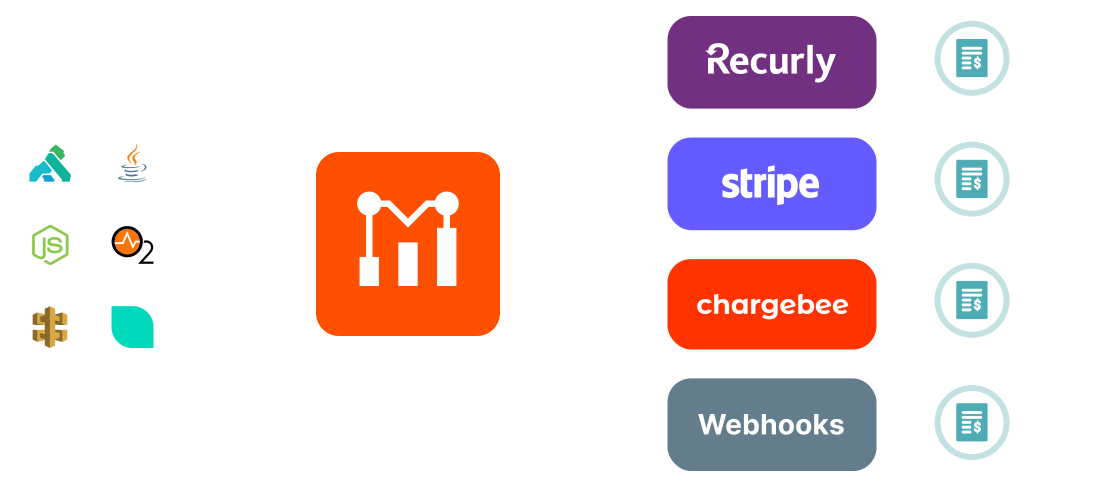
Moesif records every API call (including LLM API calls made by your application) with per-customer attribution. The billing meter aggregates usage by whatever dimension matters to your pricing (calls, tokens, MB, active users, custom events) and syncs the totals to your billing provider (Stripe, Recurly, Chargebee, Salesforce) on the cadence you choose.
The combination handles three problems most SaaS billing stacks struggle with:
- Real-time usage visibility for customers. Customers see their current usage in your product before the invoice arrives, which prevents bill-shock support tickets.
- Accurate per-customer attribution for LLM consumption. When your product calls OpenAI’s API on behalf of Customer X, Moesif tracks Customer X as the cost driver, not your aggregate company total.
- Hybrid billing models out of the box. Subscription + overage models that would otherwise require custom code are configured rather than built.
For the pricing-strategy decisions that drive billing-model choice, refer back to the model comparison earlier in this guide.
Next steps
SaaS billing is one of the parts of building a software business where early decisions compound. Pick a pricing model that fits how your product creates value, instrument metering from day one, automate dunning, and verify your revenue recognition is audit-ready before you need it to be.
If you are building a SaaS product with API or AI consumption that needs to bill back to customers, start a 14-day Moesif free trial to see per-customer attribution and billing meter sync in action. No credit card required.
Frequently asked questions
What is SaaS billing? The combination of pricing model, subscription management, invoicing, payment processing, and revenue recognition that runs a SaaS company’s revenue operations.
What is the best SaaS pricing model? Tiered subscriptions for feature-driven products, usage-based or hybrid for consumption-driven products (APIs, AI, infrastructure). The right model depends on what creates value for your customers.
What is the difference between billing and revenue recognition? Billing is when you invoice and collect cash. Revenue recognition is when you book that revenue in your accounting. For most SaaS subscriptions, revenue is recognized over the subscription period even though the cash arrives upfront.
How do I reduce involuntary churn? Implement dunning automation: smart payment retries, customer outreach when payments fail, grace periods, and clear account-state progression. Most billing platforms include this; using it well recovers a meaningful share of failed payments.
Do I need separate billing and metering tools? For pure subscription products, a billing platform alone often suffices. For products with significant usage-based pricing (APIs, AI, infrastructure), most stacks pair a billing platform with a dedicated metering platform.
How do I bill for AI and LLM consumption? Hybrid models (subscription with included token allowance plus overage) are the 2026 default. Per-customer attribution of LLM costs is a prerequisite; most general billing platforms do not handle this without an additional metering layer.

Related Articles

API Strategy
Leveraging AI For a Better API Strategy
Learn how to leverage AI to build and fortify your API strategy. Improve design, governance, documentation, and align APIs with business outcomes.
API Strategy
The 5 Best Mixpanel Alternatives of 2025
Learn about the best Mixpanel alternatives to determine the right analytics solution for your use case.

API Development
How to Leverage Moesif Effectively for API Observability
Effectively leverage Moesif for API observability through best practices for integration, event enrichment, custom actions, and engineering workflow integrat...
API Strategy
How to Build an Internal Chargeback Model for Your API and AI Usage Using Moesif
Use Moesif to implement internal chargebacks and enable precise API and AI cost attribution for better transparency and resource optimization.