API Business Analytics: Metrics, Tools, and Patterns in 2026
API business analytics is the practice of turning the data your API generates into decisions about revenue, growth, and product direction. It is different from operational monitoring (which asks “is the API up?”) and from product analytics on a UI (which asks “where did this user click?”). The question API business analytics answer is “which customers are growing, which are stalling, and what does that mean for the next quarter?”

This guide walks through what the category covers, the metrics that drive decisions, the categories of tools, and the 2026 patterns around AI consumption and agent traffic. The piece most teams get wrong is conflating API business analytics with infrastructure monitoring; they are related but distinct disciplines.
What API business analytics actually means
API business analytics measures how your API is performing as a product. It pulls from API traffic data and combines it with customer identity, billing data, and product context to answer questions like:
- Which customers are increasing their API consumption month-over-month?
- Which endpoints drive the most revenue?
- Which integrations stall between signup and first production call?
- Which customer cohorts are growing in their use of new features?
- What is the typical time from signup to first 100 calls? To first 10,000? To first paid invoice?
The data flows through three layers: the gateway (raw call records), the customer mapping (which call belongs to which account), and the business mapping (which account belongs to which segment, plan, and revenue tier). The analytics happen on the joined view.
API business analytics vs business analytics APIs (the naming confusion)
These two phrases sound alike and mean different things:
- API business analytics is the discipline above: using your own API’s data to drive business decisions.
- Business analytics APIs are APIs offered by analytics providers (Google Analytics API, Salesforce Analytics API, Sendgrid Stats API, Mixpanel’s Query API) that let your application pull analytics data programmatically.
This post is about the first. The second is a category of products you might use as part of an analytics workflow.
Why API business analytics matter
API-first companies generate most of their telemetry from API calls. Without analyzing that telemetry from a business angle, the API becomes an opaque revenue line: dollars come in, dollars go out, and the levers that change the trajectory are invisible.
The practical wins from running this analytics layer:
- Identify expansion candidates. Customers approaching plan limits or growing month-over-month are candidates for proactive upsell conversations.
- Spot churn early. Customers whose usage flattens or declines for two or three months are at risk; analytics surfaces the pattern before the renewal conversation.
- Validate pricing. Revenue per call (or per token, per active user) tells you whether your pricing model is capturing the value customers see.
- Inform product investment. Endpoints with high usage but high error rates are priority targets for engineering work. Endpoints with low usage are candidates for deprecation.
- Detect abuse and anomalies. Sudden traffic shifts (a customer spiking 10x, a new IP range hitting auth endpoints) need to be visible without waiting for an incident.
Each of these is a routine question for a product or growth team. None of them is answerable from infrastructure-level metrics alone.
The metrics that matter
The core API business metrics most teams converge on:
- Active customers per period. Daily, weekly, monthly active customers (DAC/WAC/MAC). The leading indicator for retention.
- API calls per customer per period. The unit-level measure of engagement.
- Revenue per customer per period. The output side of the value loop, paired with calls per customer to compute ARPU and CAC payback.
- First-call latency. Time from signup to first successful API call. The leading indicator for activation; high first-call latency predicts low conversion.
- Endpoint adoption. Which endpoints are gaining adoption among customers; which are stagnant or declining.
- Error rates by customer. Distinguishes “the API has bugs” from “Customer X’s integration has bugs.” Both matter, but they require different responses.
- Cohort retention. Revenue-weighted retention by signup cohort. Tells you whether new customers are converting and sticking.
These metrics are derivative of underlying call records. The analytics platform’s job is to produce them cleanly from raw traffic plus customer identity.
Categories of tools
The market roughly splits into three categories:
- Application Performance Monitoring (APM) tools. Datadog, New Relic, Dynatrace. Built for operations and SRE teams. Strong on infrastructure metrics (CPU, memory, latency percentiles); not built for per-customer business analytics or revenue attribution. The right tool when the primary question is “is the system healthy?”
- Log aggregators. Elasticsearch/Kibana, Splunk, Graylog. Built for engineering debugging. Useful for searchable raw event data but require substantial custom dashboard work to produce business-level views. The right tool when the primary question is “what happened in this specific request?”
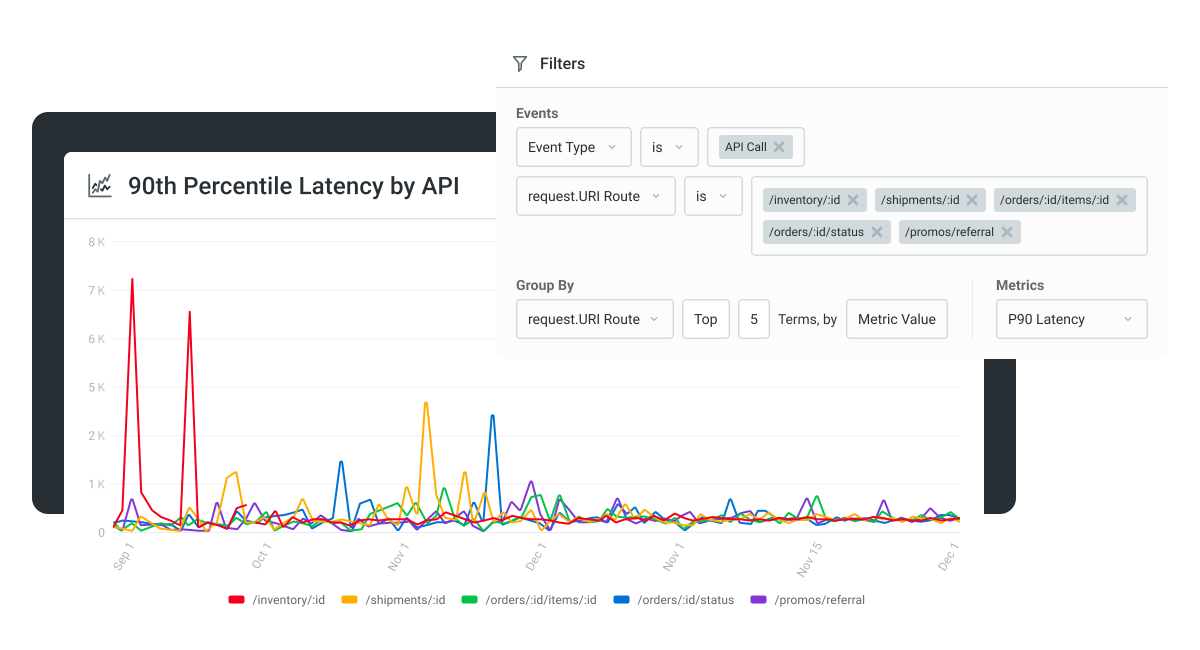
- API-specific analytics platforms. Moesif is the analytics platform paired with WSO2 in this stack and is purpose-built for API-as-a-product analytics: per-customer attribution, behavioral cohorts, revenue mapping, and per-endpoint payload-level visibility. The right tool when the primary question is “how is the API performing as a product?” (which is the question APM tools and log platforms were never designed to answer).
The right choice depends on which question dominates. Many teams end up using more than one: APM for operations, log search for debugging, and API-specific analytics for product and business decisions.
API business analytics in 2026: AI consumption and agent attribution
Two changes are worth flagging if your analytics layer is more than a year old.
AI consumption attribution. A meaningful share of API calls in 2026 either come from AI agents (calling on behalf of users) or are themselves LLM calls (your application calling OpenAI on a customer’s behalf). Both need to be attributable to the underlying customer for analytics and billing to work. The standard pattern: include a customer ID in the auth context of every call, and propagate it down to any downstream LLM API call so the cost can be re-attributed.
Agent identity as a first-class dimension. When the consumer of your API is an agent rather than a human developer, the questions you ask about that traffic are different. “Which workflows are triggering this endpoint?” matters more than “which IP is calling?” Analytics platforms are starting to expose agent identity as a built-in dimension alongside customer identity.
These shifts matter because the older analytics models, built on the assumption that one human developer drives one customer’s API usage, break when an agent runtime mediates the calls. Per-customer attribution is no longer enough; you need per-agent attribution within each customer.
How Moesif’s API business analytics work
Moesif instruments API gateways (WSO2, Kong, AWS, Azure, Envoy) and application SDKs, captures every request and response with customer identity attached, and rolls the data into analytics views built around customer behavior rather than infrastructure health.
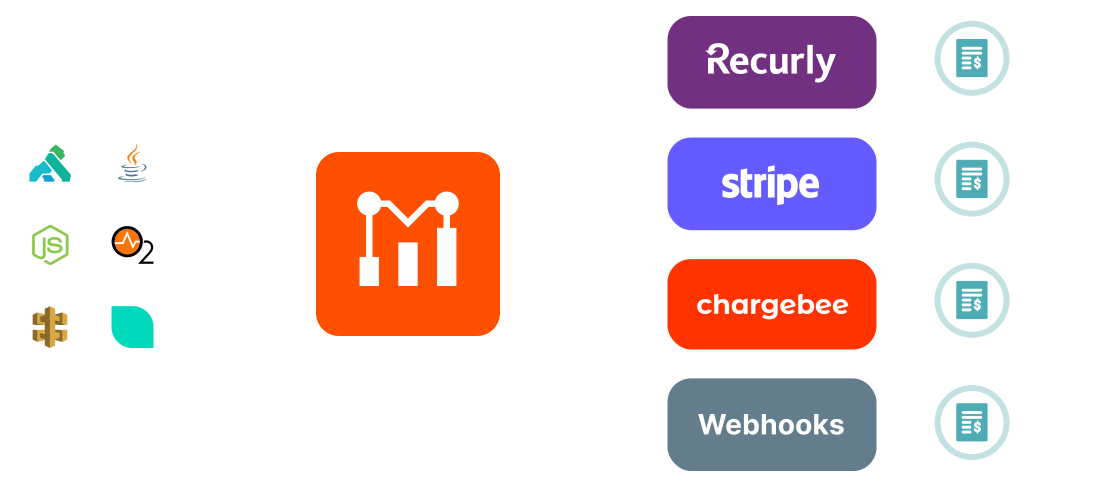
Out of the box: active customers, calls per customer, error rates per customer, endpoint adoption per customer, time-from-signup metrics, cohort retention, and per-customer revenue when integrated with a billing provider. The data feeds both product analytics dashboards and the usage-based billing meters that re-bill consumption.
The pricing-strategy decisions downstream from these analytics (per-call vs. per-token vs. tiered) are covered in our broader API pricing guidance.
Common API business analytics mistakes
The patterns we see across customer reviews:
- Treating it as an engineering project. API business analytics is a product and growth function. Engineering-only ownership produces dashboards no one outside engineering reads.
- No per-customer attribution. Anonymous traffic data cannot answer business questions. Tag every call with customer identity at the gateway layer.
- Mixing operational and business views. Dashboards that combine “p95 latency” with “weekly active customers” serve neither audience well. Build separate views for ops and for product/business teams.
- Picking tools before defining questions. Buying Datadog when your dominant question is “which customers should we upsell” produces a dataset you cannot answer that question from. Pick the tool that fits the question, not the other way around.
Next steps
API business analytics is one of the higher-leverage instrumentation decisions an API-first company makes. The metrics are operationally cheap to capture if you do it at design time, and the questions they answer drive the largest decisions about pricing, product, and customer success.
If you want per-customer, per-endpoint analytics on your live API within an hour of integrating, start a 14-day Moesif free trial. No credit card required.
Frequently asked questions
What is API business analytics? The discipline of turning API call data into business decisions: identifying expansion candidates, spotting churn early, validating pricing, informing product investment.
How is API business analytics different from APM? APM (Datadog, New Relic) focuses on infrastructure and application health. API business analytics focuses on customer behavior and revenue. Different audiences, different questions, often used together.
What metrics should I track? Active customers, calls per customer, revenue per customer, first-call latency, endpoint adoption, error rates per customer, cohort retention. The exact set depends on your business model.
Can I use Datadog or New Relic for API business analytics? They can be configured to produce some of these views with custom dashboards, but they were not built for it. API-specific platforms like Moesif handle the per-customer behavioral cuts out of the box.
How do I attribute LLM consumption to customers? Propagate the customer ID through your application down to the LLM API call, and record the token usage with the customer ID attached. Analytics platforms that handle this (including Moesif) are built specifically for the pattern.
Do AI agents change my analytics needs? Yes. Per-customer attribution is no longer enough; you also need per-agent attribution within each customer. Most platforms are catching up to this in 2026.

Related Articles

API Strategy
Leveraging AI For a Better API Strategy
Learn how to leverage AI to build and fortify your API strategy. Improve design, governance, documentation, and align APIs with business outcomes.
API Strategy
The 5 Best Mixpanel Alternatives of 2025
Learn about the best Mixpanel alternatives to determine the right analytics solution for your use case.

API Development
How to Leverage Moesif Effectively for API Observability
Effectively leverage Moesif for API observability through best practices for integration, event enrichment, custom actions, and engineering workflow integrat...
API Strategy
How to Build an Internal Chargeback Model for Your API and AI Usage Using Moesif
Use Moesif to implement internal chargebacks and enable precise API and AI cost attribution for better transparency and resource optimization.