What You Need to Know About API Pricing in 2026
Pricing APIs correctly is a key part of your API monetization strategy. That means understanding how you should charge for usage, whether it is better to set your pricing by month or quarter, whether data tiers or a pay-as-you-go model would work best, and a whole host of other elements. In 2026 it also means competing with how buyers think about LLM token pricing, designing for AI agents that consume your API at machine speed, and giving enterprise customers the chargeback views their finance teams now expect.

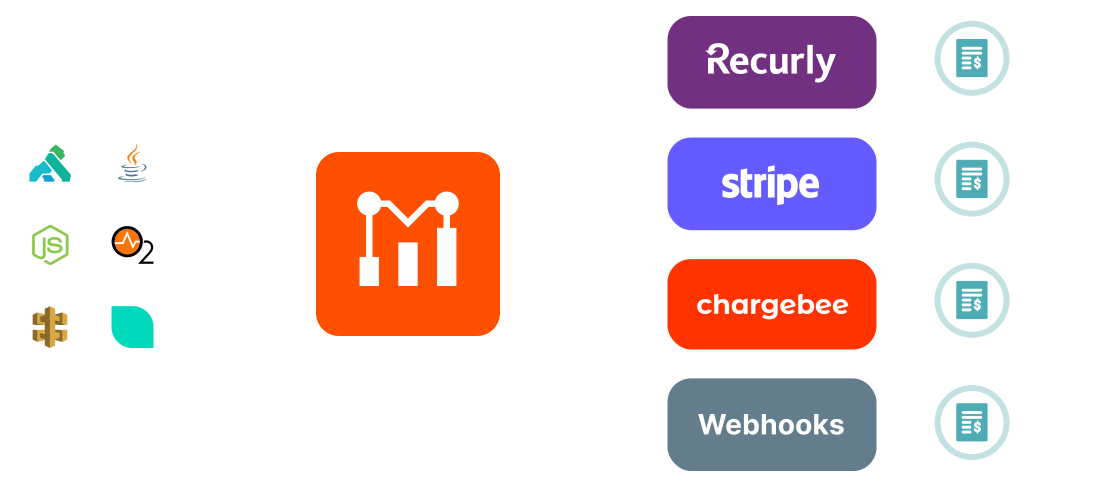
This post walks through everything you need to know when pricing APIs in 2026.
Why API pricing got harder in 2026
Three shifts in the last 18 months reshaped the conversation.
LLM APIs reset the price floor. When buyers compare a generic REST API against GPT-class endpoints, they expect prices measured in fractions of a cent per call. A $0.10-per-call transactional API now feels expensive even when the underlying value is high.
AI agents consume APIs autonomously. A single human session can trigger dozens of downstream API calls through tool-using agents. Pricing models built for “one user, one call, one bill” leak revenue when an agent is doing the calling.
Chargeback is back in the conversation. With LLM spend ballooning inside enterprises, finance teams want engineering to attribute API and AI costs back to the business unit that drove them. That changes what your customers want to see in their bill, not just what they pay.
Every section below is written with those three pressures in mind.
Building a pricing strategy for your APIs
Who pays for an API?
At the most basic level it is important to ask who actually pays for an API. As an API provider, monetizing your existing API starts with charging the end user, the businesses that are utilizing your API to provide business value. So, by understanding the value that your API provides, you will be better able to build a favorable pricing strategy.
One of the founding principles when treating your API as a Product is to understand your customer. By seeing how they use your product, you will not only be better able to price your service, you will also get the insights you need to decide what to ship next.
How do you calculate API price?
There are several ways to determine what your API is worth. Charging by API call is one common pricing metric, but it is no longer the only option. Different usage-based billing approaches to consider when mapping out your complete API strategy:
- Transaction volume, based on API call count. Ideal for APIs and event-based platforms in communications (Twilio) or analytics (Moesif).
- Token or unit volume, based on input and output tokens. Mandatory for any LLM-wrapping API, and increasingly common for any API that returns variable-sized payloads.
- Revenue or cost share, where you charge the end user a percentage of revenue or transaction fees. Well suited to payment platforms (Stripe is the canonical example).
- Data volume, based on gigabytes sent or minutes processed. A good approach for platforms focused on data, such as logging or storage (the AWS S3 model).
- User-centric, pricing based on the number of monthly active users. A modern version of per-seat licensing.
- Resource-based, by compute units or active hours. Ideal for compute-heavy infrastructure such as databases or virtual machines.
- Hybrid or value-metric, combining two of the above (for example, a base subscription with per-call overage). The dominant model among public API companies above $10M ARR.
The product you are offering plays a key role in your pricing strategy. There is much to be learned from SaaS pricing, since most API pricing models inherit from it. Leading thinking on SaaS pricing emphasizes setting prices based on three main factors: the cost of delivering your product, what your competitors charge, and the value metrics your customers care about. Feedback from your first ten paying customers is also key, because they will have plenty of thoughts on which plan will and will not work for them.
Where Moesif fits: the harder problem after picking a model is metering on the unit your buyer values. Moesif’s usage-based billing lets you bill on any field inside the request or response, so you can ship a token-based or hybrid model without rebuilding your billing pipeline.
Internal versus external APIs
External-facing APIs, the ones available to other companies outside your organization, often perform actions on behalf of users and are often charged for. Internal APIs, which you might use to interconnect different services within your organization, are not usually charged for. The 2026 wrinkle is internal chargeback: even when you do not charge another company for an internal API, the team that owns it increasingly needs to attribute its cost back to the business units that consume it. We have a full walkthrough on building an internal chargeback model if you need one.
Pay-as-you-go pricing
The pay-as-you-go billing model means that customers pay only for what they consume. That could be measured by a range of metrics, such as number of messages sent. This consumption-based subscription model is well suited to APIs, which are naturally transaction-based.
With pay-as-you-go API billing, you choose which metrics to charge on based on your customers’ usage. You can also implement volume discounts depending on how you monetize your API.
The pay-as-you-go model is easy to implement, which makes it a popular choice for many companies devising their first API monetization strategy. From your customers’ perspective, pay-as-you-go billing is cheap to adopt. However, it can be more expensive for them in the long run if usage is not capped. You will also need to implement a system with the capability to alert your users around quota limits to avoid surprise bills. Such a system works to your credit, because it avoids surprise bills prompting your customers to shop around for cheaper alternatives. Pairing pay-as-you-go with behavioral emails for usage alerts is the standard pattern.
How are API calls calculated?
There are many different ways to calculate how you bill for your APIs. This is where Moesif really shines, since the platform can bill based on any parameter in your API. It means you can shape your API monetization strategy around your customers’ precise requirements. If you have decided on usage-based billing, possible consumption metrics include number of API calls, gigabytes sent, minutes consumed, monthly active users, active hours, or any field inside the request body.
How much can an API make?
Another key question, regardless of pricing strategy, is how much your API can generate. APIs are a subset of SaaS and have proven time and time again to be capable of scaling at hypergrowth speeds.
The two original poster-children for API success are still instructive. Stripe and Twilio both built their businesses on an API-first model. After launching its product in 2011, Stripe scaled from $40M in revenue in 2016 to a multi-billion-dollar net revenue figure within a decade, all on transaction-fee pricing. Twilio grew from $50M in revenue in 2013 to several billion in annual revenue, on usage-based pricing applied to every API surface they sell.
The 2026 entrants worth studying are the LLM API providers (OpenAI, Anthropic, Google) who used token-based pricing with cached-input discounts to grow API revenue faster than any SaaS company in history. The lesson is not to copy LLM pricing. The lesson is that pricing models are malleable, and the providers who reprice fastest grow fastest.
API or enterprise software implications?
If you have the option of offering an API product or an enterprise software solution, this decision affects how you deploy and generate revenue. One strategy is to focus on offering just your API to end users, which lets you get to market faster and focus all of your engineering talent on the business logic. Going the enterprise software route means investing in a frontend too, and by focusing all of your resources on differentiated business features, you may be able to charge more.
Tiered pricing: decide price points and package accordingly
When developing a tiered pricing model, it is up to you to decide price points and package your tiers accordingly. It has become increasingly common to adopt a “freemium” pricing strategy, where the starter tier is free and the later tiers are paid. In Moesif’s case, we have four tiers (Free, Grow, Pro, and Enterprise), providing a concrete example of how to structure pricing.
There are trade-offs between transactional and tiered product pricing models. If you are using the tiered approach, you will need to define which features and usage quotas are included in each tier. You will also need to address customers’ primary concern with this model:
What happens if I reach the API plan’s limit?
Each tier defines usage, number of users, and features. If a customer needs more, they have the option to subscribe to the next tier as part of their planned growth. It is a simple model that makes it easy for the customer to budget and administer, so it is certainly one to consider as part of your API pricing strategy.
What is a premium API business model?
The other benefit of tiered pricing is that you can introduce premium elements. A premium API business model is one where top-tier customers benefit from features that are not available on any other tier. In Moesif’s case, premium extensions include the ability to sync API usage data to on-premise warehouses, Salesforce integration, MarTech tools, and more. The premium API elements you can offer will be based on your unique business model and use case.
Hybrid: tiered base plus metered overage
The model most public API companies converge on as they scale. A flat base fee covers a quota of usage, and overage is charged per unit. This gives the customer predictability for normal usage and gives you upside on growth.
If you only build one pricing model in 2026, build this one. It is the model behind the majority of API businesses above $10M ARR. The trick is metering the overage in a way the customer can predict and see in-product.
Department chargeback (new in 2026)
Inside large enterprises, the buyer is increasingly the platform team, and the platform team’s job is to redistribute API and AI cost to the business units that consume it. The WSO2 AI Gateway governs API, LLM, and MCP traffic from one control plane with token-level visibility and the ability to allocate token budgets to teams and workloads. Moesif sits behind the gateway and attributes every API and LLM call back to a user, organization, or cost center. If your buyer is Fortune 500, expect chargeback to be in the RFP.
Pricing for AI agents and MCP servers
A meaningful share of API traffic in 2026 comes from AI agents, not humans. When you expose your API through an MCP server, the consumer of your endpoints is a model, not a developer. That changes pricing in three ways.
Volume is higher and burstier. An agent can make dozens of calls to resolve what a human would have made one call for. Per-call pricing extracts more revenue from agent traffic, but it also raises the perceived cost, because buyers compare it directly against their LLM bill.
Per-agent attribution matters. Buyers want to know which agent or workflow drove which spend. This is the chargeback story above, repeated inside a single customer’s account.
Caching is a pricing lever, not just a performance lever. OpenAI and Anthropic both discount cached input tokens, and the WSO2 AI Gateway uses semantic caching to reduce repetitive calls. If your API benefits from caching, exposing a cache-hit discount is now an expected part of the menu.
If you are exposing an MCP server, the safest 2026 default is hybrid pricing (base subscription plus metered overage) with separate metering on cache hits and per-agent attribution on top.
Does the API address a unique need?
The final element of pricing APIs relates to the value your product delivers. Ask yourself: does this API address a unique need? If it does, you have greater freedom in terms of pricing than if your API serves a need that many competitors also address.
Ease of use also comes into play, so consider how accessible your API is. Is it a REST API or another format? Is it cloud-based or does it run on premises? Will developers need an API key, and if so, is the process of obtaining it frictionless? Customers will be happier to pay for an API that is easy to use and comes with clear code examples than an API that causes them headaches.
Mistakes that kill API pricing strategies
These are the patterns we see most often when WSO2 and Moesif customers come to us mid-implementation.
Pricing on a unit nobody owns. Charging per “transaction” when nobody on the customer’s side can predict their own transaction count is how you create surprise bills. Pick a unit your buyer can forecast.
Launching with one model and refusing to change it. The fastest-growing API businesses reprice every six to twelve months. Treat your pricing page like a product surface, not a contract.
Hiding overage charges in the fine print. Customers will tolerate overage; they will not tolerate finding out about it at the end of the billing cycle. Show running spend in-product, alert customers at 80% of their quota, and let them upgrade in two clicks.
Forgetting the buyer’s CFO. Engineering buys APIs; finance pays for them. If your bill is not exportable and attributable to a cost center, the renewal conversation gets harder than it needs to.
Pricing AI workloads like REST workloads. A model can consume your API a hundred times to satisfy one human intent. If your pricing extracts revenue per call but the perceived value lives at the intent level, you are setting up a renegotiation. Meter on the unit the customer values, not the unit you serve.
How Moesif and WSO2 cover end-to-end API monetization
Most API monetization stories stop at “pick a model and bill for it.” The harder problems show up later: attributing cost to the right user, exposing live usage to the customer, and metering on a unit that did not exist when you wrote your terms of service.
Moesif handles those problems as part of the WSO2 API Platform. WSO2 secures and governs every API, LLM, and agent call through its API Manager and AI Gateway, across any gateway (WSO2, Kong, AWS, Azure, Envoy) and any deployment model (SaaS, hybrid, self-hosted). Moesif sits behind the gateway and meters every call on any parameter, attributes cost to the right user, organization, or cost center, surfaces live usage and quota alerts to your customers, and syncs billing events to Stripe, Chargebee, Salesforce, or a data warehouse.
If you are pricing a B2B API, an internal AI gateway, or an MCP-based agent product in 2026, this is the integrated stack to evaluate.
Set up your pricing today
API pricing is a strategy problem, not a math problem. Get the unit right, build a model your customer can predict, and instrument every call so you can change the model when the market does. The earlier you instrument, the more options you have.
Take the plunge today. Start a 14-day Moesif free trial and meter your APIs on any parameter in the request or response. No credit card required. If you are pricing an AI or MCP product at enterprise scale, the WSO2 API Platform team can walk through the integrated architecture with you.
Frequently asked questions
What is API in pricing? “API pricing” is the strategy and mechanics by which an API provider charges customers for access. It covers what unit you charge on (calls, tokens, users, revenue share), how you package those units into plans, and how you bill and report on them.
How much does it cost to have an API? As a consumer, costs range from free tiers (Gemini and OpenAI both have generous free quotas) to several dollars per million tokens for high-end models, to flat $50-$500/month subscriptions for productivity APIs. As a provider, the cost to build and operate a paid API is dominated by gateway and observability tooling, payments infrastructure, and engineering time; the marginal cost per call is usually a fraction of a cent.
How is API pricing calculated? Three inputs: the cost of delivering one unit of the API, what comparable APIs charge, and the value the customer gets per unit. The price per unit lives somewhere between cost-plus and value-based. Most providers start cost-plus and migrate toward value-based as they understand their customer better.
What is the best pricing model for an API in 2026? Hybrid: a subscription base that covers a baseline quota, plus metered overage above it. This is the model most public API companies converge on by the time they pass $10M ARR. For AI and MCP-exposed APIs, layer per-agent attribution and a cache-hit discount on top.

Related Articles

API Strategy
Leveraging AI For a Better API Strategy
Learn how to leverage AI to build and fortify your API strategy. Improve design, governance, documentation, and align APIs with business outcomes.
API Strategy
The 5 Best Mixpanel Alternatives of 2025
Learn about the best Mixpanel alternatives to determine the right analytics solution for your use case.

API Development
How to Leverage Moesif Effectively for API Observability
Effectively leverage Moesif for API observability through best practices for integration, event enrichment, custom actions, and engineering workflow integrat...
API Strategy
How to Build an Internal Chargeback Model for Your API and AI Usage Using Moesif
Use Moesif to implement internal chargebacks and enable precise API and AI cost attribution for better transparency and resource optimization.