5 Best Python REST API Frameworks in 2026 (Tested & Compared)
Python is still one of the most popular languages for building REST APIs. The reason has shifted, though. Five years ago, Python was the convenient choice for backend developers; today, it is also the default for serving AI and ML models, which means a meaningful share of new Python APIs live behind a model rather than a database. That changes which frameworks are worth picking up first.


This post walks through the five frameworks we recommend for new Python REST APIs in 2026, based on the JetBrains State of Python 2025 survey (published September 2025) and the real-world patterns we see across Moesif and WSO2 customers.
How to pick a Python REST API framework
Before the list, the criteria. The right framework depends on three things.
What you are serving. A pure REST API on top of a database is one job. Serving a machine learning model in production is another. A real-time WebSocket app is a third. Different frameworks optimize for different shapes.
Sync or async. Modern Python (3.8+) supports both. Async is the right default for APIs that fan out to other services or models; sync is fine for CRUD-heavy APIs against a single database.
Batteries included or bring-your-own. Some frameworks ship with authentication, ORM, admin panel, and more. Others give you a router and let you assemble the rest. Match the framework’s opinion to how much your team wants to make their own choices.
A fourth criterion that matters less than it used to: raw performance. Modern Python frameworks are all fast enough for almost any business workload. Unless you are serving millions of requests per second, framework choice is not the bottleneck.
For the broader design decisions that shape your API regardless of framework, see our API design principles guide.
1. FastAPI
Best for: new APIs, ML model serving, async-first workloads, teams that value type safety.
FastAPI is the highest-ranked Python web framework in JetBrains’ most recent State of Python survey, with adoption that has climbed sharply year over year. It was built around three modern Python ideas: async/await for concurrency, type hints for validation, and OpenAPI for documentation.
The result is a framework that auto-generates an OpenAPI spec and an interactive Swagger UI directly from your function signatures, validates requests against Pydantic models automatically, and runs on the ASGI stack for native async support.
Advantages:
- Async-native, ideal for ML serving and streaming endpoints
- Auto-generated OpenAPI spec and interactive docs
- Type hints catch bugs at editor-time
- Strong community momentum among new projects
Trade-offs:
- Steeper learning curve for developers new to async/await
- “Batteries not included,” meaning you choose your own auth, ORM, and admin tools
- Smaller ecosystem of integrations than Django
If you are starting a new Python REST API in 2026 and the team is comfortable with async, FastAPI is the safe default. The 2025-2026 ecosystem moves matter here: the framework’s creator launched FastAPI Cloud (a managed deployment platform; private beta with a public waitlist at fastapicloud.com at the time of writing) for deploying a FastAPI app with a single fastapi deploy command, and the fastapi[standard] install now includes the fastapi dev CLI command that smooths out the gap between local development and production runs.
2. Django REST Framework
Best for: teams already using Django, enterprise backends, content-heavy applications.
Django REST Framework (DRF) is the API extension to Django, the long-standing full-stack Python web framework. The JetBrains survey shows Django itself at 35% usage and DRF specifically at 20% usage in 2024.
DRF builds directly on Django’s models, views, and authentication, which makes it the natural choice when you are already shipping a Django app and want to expose a REST API on top. The browsable API interface (an in-browser explorer for your endpoints) is a feature long-time DRF users miss when they leave for other frameworks.
Advantages:
- Deep Django integration; reuse models, auth, and middleware
- Browsable API for interactive testing during development
- Built-in permissions and serialization out of the box
- Mature ecosystem with documentation and third-party packages
Trade-offs:
- Tightly coupled to Django; not the right choice if you do not already use it
- Heavier setup than lightweight alternatives
- Sync by default; async support is partial and less polished than FastAPI’s
If your team is already in Django, DRF is the path of least resistance.
3. Flask
Best for: small APIs, microservices, internal tools, ML prototypes that need to ship behind an HTTP endpoint quickly.
Flask remains one of the most popular Python web frameworks (34% usage in the same survey). It is a “microframework”: a small router on top of Werkzeug (WSGI) and Jinja2 (templating), with everything else added by extensions when you need it.
For REST APIs specifically, most teams pair Flask with an extension like Flask-RESTful or Flask-Smorest, which add API-specific features (resource classes, automatic serialization, OpenAPI generation).
Advantages:
- Lightweight, easy to understand from the first line of code
- Huge community and a large catalog of extensions
- Excellent for small services and data-science prototypes
- Beginner-friendly
Trade-offs:
- Sync by design; not the right choice for high-concurrency async workloads
- “Bring your own everything,” so auth, ORM, and admin must be added manually
- Without conventions, large Flask apps can become hard to maintain
Flask is a good first framework and a good choice for small APIs. For new large APIs in 2026, FastAPI usually wins.
4. aiohttp
Best for: async-first APIs, WebSocket-heavy applications, servers that also need to make many outbound HTTP calls.
aiohttp is an asynchronous HTTP server and client toolkit. The JetBrains survey shows 13% usage in the same survey. Unlike Flask or DRF, it is async by default; unlike FastAPI, it does not lean on type hints for validation, which makes it lower-level and more flexible.
Teams reach for aiohttp when they want close control over the async event loop, native WebSocket support, or a single library that serves both incoming and outgoing HTTP traffic.
Advantages:
- Native async/await throughout
- Built-in WebSocket support
- Functions as both a server and a client library
- Mature and well-maintained
Trade-offs:
- Lower-level than FastAPI; less convenience for typical REST APIs
- Validation, OpenAPI, and middleware are all bring-your-own
- Smaller pool of tutorials and Stack Overflow answers compared to Flask or FastAPI
If you are building an async microservice that does heavy WebSocket or outbound-HTTP work, aiohttp is worth a serious look.
5. Falcon
Best for: high-throughput REST APIs, microservices where every millisecond matters.
Falcon is a minimalist Python web framework designed specifically for REST APIs at scale. It does not appear in the top of JetBrains’ general survey because it is intentionally niche, but it ships in production at companies that need raw throughput. It is one of the fastest Python web frameworks on standard benchmarks, partly because it does very little for you.
Falcon’s philosophy is opposite Django’s. Where Django ships everything, Falcon ships nothing beyond routing and request/response objects. The result is a small surface area and predictable performance.
Advantages:
- Extremely fast for a Python framework
- Small, predictable, easy to reason about
- Stable API that has changed slowly over years
Trade-offs:
- No batteries included; you assemble auth, validation, and serialization yourself
- Smaller community and ecosystem than FastAPI or Flask
- The performance edge matters less in 2026 now that other frameworks have matured
Pick Falcon when you have a clear performance need and your team is comfortable assembling its own stack.
What about Litestar, Sanic, or Starlette?
Three honorable mentions worth knowing about:
- Starlette is the ASGI toolkit that FastAPI is built on top of. You can use Starlette directly if you want async routing and middleware without FastAPI’s Pydantic-and-OpenAPI opinions. It is the right choice when you need an async foundation and want to build the framework you actually want.
- Sanic is an async framework similar in spirit to Flask but designed for async from the start. It has a dedicated user base for high-concurrency workloads but has lost mindshare to FastAPI for new projects.
- Litestar (formerly Starlite) is an ASGI framework that emphasizes type safety, performance, and developer ergonomics. It is younger than FastAPI but well-regarded among teams that want FastAPI’s ideas with different design trade-offs (full DI container, plugins, slightly different validation philosophy).
For most teams, the five primary frameworks above cover the practical choices. These three are good to know exist for the cases where the primary five do not fit.
Side-by-side comparison
| Framework | Async | Batteries | Best for | Adoption signal |
|---|---|---|---|---|
| FastAPI | Native | Light | New APIs, ML serving | Top-ranked in JetBrains survey, growing fast |
| Django REST Framework | Partial | Heavy | Enterprise, existing Django teams | Default in Django shops |
| Flask | No | Light | Small APIs, prototypes | Long-time top of the JetBrains survey |
| aiohttp | Native | None | Async microservices, WebSocket apps | Smaller, focused user base |
| Falcon | Optional | None | High-throughput REST APIs | Specialized, performance-driven |
For the underlying HTTP method conventions that all five frameworks expose, our API methods reference covers GET, POST, PUT, PATCH, and DELETE.
Adding observability and monetization
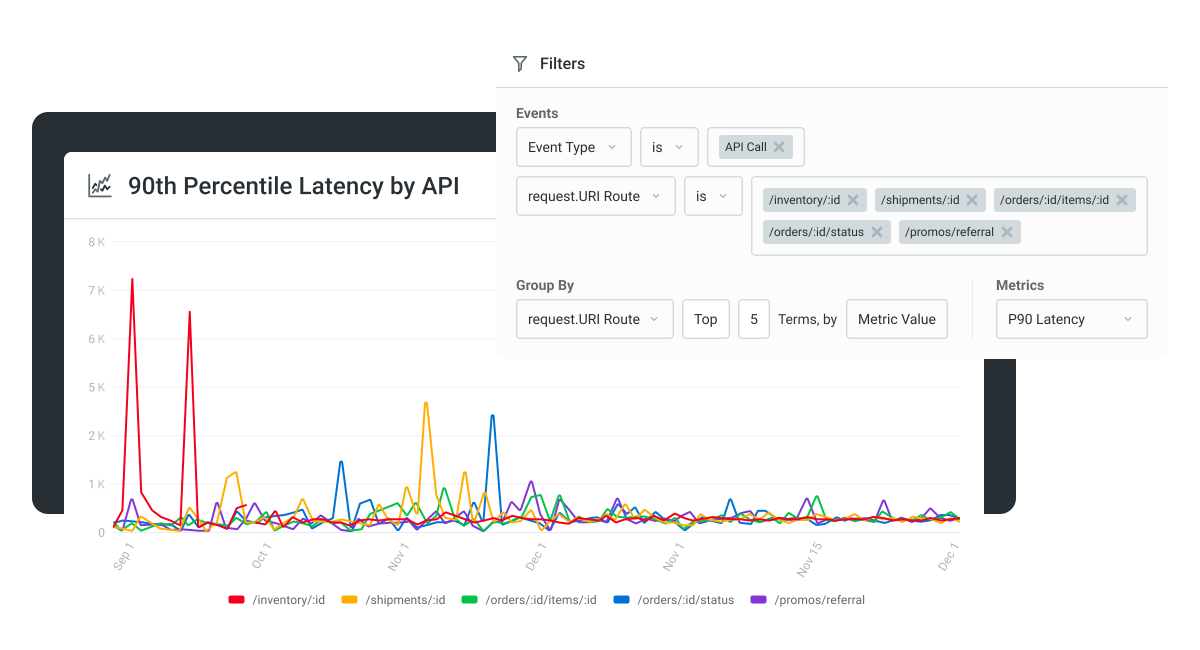
Building the API is only the start. Once your Python API is in production, you will want to monitor and analyze incoming traffic to identify performance issues, security flaws, and how your endpoints are actually being used.
Moesif integrates with Python frameworks through an SDK and is running in minutes. Once integrated, you can see:
- Live API traffic with per-endpoint, per-customer breakdowns
- Time-series reports on usage and latency
- Conversion funnels from signup to first successful call
- Retention reports across customer cohorts
Moesif also handles API monetization, syncing usage to billing providers like Stripe, Recurly, or Chargebee. If you are serving an ML model or any API where customers expect granular billing, this is the layer that closes the loop between the framework you chose and the business outcomes you care about.
Wrapping up
The Python framework landscape is in a clearer place than it was a few years ago. FastAPI is the new default for new APIs, Django REST Framework holds the enterprise position, Flask remains the lightweight choice, and aiohttp and Falcon serve specific async or performance use cases. Pick based on your team’s existing skills, your throughput needs, and whether you want a framework with opinions.
Once your framework is in place, the next step is seeing what your API is actually doing in production. Start a 14-day Moesif free trial to get per-endpoint, per-customer analytics on the Python API you ship. No credit card required.
Frequently asked questions
What is the best Python framework for REST APIs in 2026? For most new projects, FastAPI. If you are already on Django, Django REST Framework. Flask remains a strong choice for small APIs and prototypes.
Is FastAPI better than Flask? For new REST APIs, generally yes. FastAPI is async-native, type-safe, and auto-generates docs. Flask is still excellent for small synchronous APIs, internal tools, and prototypes where you want minimal opinion.
Is Django REST Framework still relevant? Yes. DRF is the default at enterprises that already use Django. It is not displacing FastAPI for new projects, but it is the right choice for the millions of existing Django codebases that need to expose REST APIs.
What about Pyramid or Web2py? They still exist and have communities, but neither appears in the top of mainstream surveys in 2025 or 2026. For new projects, the five frameworks above cover the practical choices.
Which Python framework is best for serving ML models? FastAPI is the dominant choice for ML serving. Its async support, type validation, and Pydantic integration map well to the inputs and outputs of ML inference endpoints.
Do these frameworks all support OpenAPI? FastAPI generates OpenAPI specs automatically. Flask (with Flask-Smorest), DRF (with extensions like drf-spectacular), and Falcon can generate specs with additional setup. aiohttp does not generate them by default.

Related Articles

API Strategy
Leveraging AI For a Better API Strategy
Learn how to leverage AI to build and fortify your API strategy. Improve design, governance, documentation, and align APIs with business outcomes.
API Strategy
The 5 Best Mixpanel Alternatives of 2025
Learn about the best Mixpanel alternatives to determine the right analytics solution for your use case.

API Development
How to Leverage Moesif Effectively for API Observability
Effectively leverage Moesif for API observability through best practices for integration, event enrichment, custom actions, and engineering workflow integrat...
API Strategy
How to Build an Internal Chargeback Model for Your API and AI Usage Using Moesif
Use Moesif to implement internal chargebacks and enable precise API and AI cost attribution for better transparency and resource optimization.