API Acronym: What Does API Stand For? (2026 Guide)
The API acronym stands for Application Programming Interface. It is the contract that lets one piece of software ask another for data or for an action to be performed. When you tap “Pay with PayPal” on a shopping site, your browser is calling PayPal’s API. When ChatGPT looks up the weather, it is calling a weather API. The term has been around since the 1960s, but APIs as we know them today, HTTP, JSON, self-service signup, public documentation, are mostly a product of the last twenty years.

This guide walks through what the acronym actually means, where the term came from, how an API call works end-to-end, the types of APIs you will encounter, the difference between APIs and the things they get confused with, and how the conversation changed in 2026 with the arrival of AI agents and the Model Context Protocol.
What does the API acronym stand for?
API stands for Application Programming Interface. The Application is the software that exposes the interface; Programming signals that the interface is meant to be consumed by other code, not by a human clicking buttons; and the Interface is the contract that defines how the asking and answering happens.
Each word in the acronym is doing work, and reading them in order is the cleanest way to remember the concept:
- Application: the system being talked to. Could be a payments service, a maps server, a language model.
- Programming: the consumer is code, not a person browsing a UI.
- Interface: a documented contract: send these requests, get these responses.
The acronym is sometimes spelled out as “Application Program Interface” (older usage from the 1960s and 1970s). The modern form, and the one used universally in 2026, is “Application Programming Interface.”
Where the term “API” came from (the actual history)
The phrase “application programming interface” first showed up in computer science literature in the 1960s, referring to the boundary between an application and the operating system it ran on. For decades it meant exactly that: OS-level function calls in C or assembly, with examples like the POSIX API on Unix and the Win32 API on Microsoft Windows. There was no HTTP involved.
The term broadened in the 2000s as the web matured and services started talking to each other over HTTP. Three milestones from that era anchored the modern usage:
- 2000: Roy Fielding published his dissertation on Representational State Transfer (REST), defining the architectural style behind most modern web APIs.
- 2000: Salesforce launched what is widely cited as the first commercial web API, allowing partners to integrate against its CRM data over the internet.
- 2002: Jeff Bezos issued the “Bezos API Mandate” inside Amazon, requiring every team to expose its data and functionality through service interfaces. This is what eventually made Amazon Web Services possible.
The third wave came in the 2010s when API-first companies showed that a business could be built entirely around exposing a single API to outside developers. Twilio launched its Voice API in 2008 (with SMS following in 2010) and grew into a multi-billion-dollar company. Stripe followed in 2011 with payments. By the mid-2010s, the assumption shifted: when someone said “API,” they almost always meant an HTTP-based interface returning JSON.
That assumption holds in 2026, with one new wrinkle (covered later): some APIs are now also exposed through the Model Context Protocol for AI agent consumption.
How an API actually works (with verified examples)
The simplest API call has three parts: a client (your code), an endpoint (a URL), and a response (usually JSON).
A working example you can run from any terminal:
curl https://api.github.com/users/torvalds
That single line is a complete API call. It sends an HTTP GET request to GitHub’s user API, asking for information about the user torvalds. GitHub’s server processes the request and returns a JSON document containing the user’s profile data: name, public repositories, follower count, account creation date.
A more complex call adds authentication and a body:
curl -X POST https://api.stripe.com/v1/charges \
  -u sk_test_YOUR_KEY: \
  -d "amount=2000" \
  -d "currency=usd"
This calls Stripe’s API to create a $20 charge. The structure is the same, client, endpoint, response, but with more parameters. The -u flag adds an API key for authentication; the -d flags add fields in the request body.
In both examples, your client sends an HTTP request to a documented URL. The server’s code receives it, runs the business logic (look up a user, charge a card), and returns a JSON document. That is the whole pattern. Everything else, auth schemes, rate limits, request validation, schemas, is implementation detail layered on top.
For the deeper anatomy of what an API endpoint actually is, we have a dedicated guide.
The types of APIs you’ll encounter in 2026
The “API” acronym applies to a handful of shapes that share the same idea. The five most common in 2026:
| Style | Default protocol | Best for |
|---|---|---|
| REST | HTTP/JSON | Public web APIs, most B2B integrations |
| GraphQL | HTTP/JSON (single endpoint, query language) | Client-driven data fetching, mobile apps |
| gRPC | HTTP/2 binary | Service-to-service inside a mesh |
| SOAP | HTTP/XML | Regulated enterprise (banking, insurance) |
| Webhook | HTTP (inverted: provider calls you) | Event notifications |
REST is the dominant style by a wide margin. If a 2026 article says “API” without further qualification, it almost certainly means REST/JSON over HTTP.
A sixth shape that became relevant in 2025-2026 is the MCP server, which exposes an existing REST API in a form AI agent runtimes can consume directly. That is not a separate API style; it is a wrapper around an existing one. We come back to it in the 2026 section.
API vs SDK vs library
These three terms get conflated constantly. They are related but distinct.
- API: the interface itself. The contract that says “send these requests, get these responses.” The API lives on the server (or as a public spec).
- SDK: Software Development Kit. A package of tools, libraries, code samples, and documentation that helps developers in a specific language call the API more easily. Stripe ships SDKs for Node.js, Python, Ruby, Go, PHP, and others, each wrapping the same underlying REST API.
- Library: a reusable piece of code you import into your application. An SDK is usually built from one or more libraries plus auth helpers, retry logic, type definitions, and tutorials.
In practice: the API is the thing being called; the SDK is what you import to make calling easier; the library is the actual code inside the SDK. A developer who has integrated Stripe will say “I use the Stripe SDK”, what they mean is “I import Stripe’s Node.js library, which wraps Stripe’s REST API.”
The distinction matters because not every API has an SDK. Some APIs publish only a REST spec and let consumers use whatever HTTP client they want. Others ship SDKs in twelve languages. Both are legitimate.
Real-world examples developers use every day
The APIs you almost certainly touch in a normal workweek:
- Stripe: payments. Charge cards, manage subscriptions, handle disputes.
- Twilio: communications. Send SMS, place voice calls, run conversational flows.
- OpenAI, Anthropic, Google Gemini: LLM completions. Generate text, classify content, run agentic workflows.
- GitHub: code, issues, pull requests, and CI/CD events.
- AWS, Google Cloud, Azure: infrastructure provisioning. Spin up servers, manage databases, schedule jobs.
- Google Maps / Mapbox: geolocation, routing, geocoding.
- Salesforce: CRM data, customer records, sales pipeline.
- Slack: messaging integrations, app installations, bot interactions.
Every company above exposes documented public APIs, ships SDKs in major languages, and operates a developer portal where outside engineers register, get credentials, and start integrating. Several of them are multi-billion-dollar businesses in part because the API itself is the product.
What changed about APIs in 2026
Two shifts that did not exist five years ago changed how the acronym is used in conversation.
AI agents are first-class API consumers. When a model like Claude or GPT completes a task that involves looking something up, making a purchase, or writing a record, it is calling APIs. A meaningful share of API traffic in 2026 is non-human; the agent runtime translates a user’s natural-language intent into specific endpoint calls. APIs designed for human integration still work, but a few patterns matter more now: idempotency keys on POSTs (because agents retry), clear operationId and description fields in the OpenAPI spec (because agents read them to choose endpoints), and per-agent attribution in observability (because tracing traffic to a customer is no longer enough).
The MCP protocol gave APIs a new surface. The Model Context Protocol, introduced in late 2024 and now broadly adopted, exposes existing REST APIs to agent runtimes in a semantically richer form. The WSO2 AI Gateway auto-generates an MCP server from any OpenAPI spec, so the same API a company publishes for human developers becomes agent-consumable without a separate build. The acronym still stands for Application Programming Interface; the “application” doing the programming is increasingly a model.
These shifts do not change the definition. They change which design and operational decisions matter most.
Tools you’ll use to work with APIs (a 2026 starter set)
If you are new to APIs, the ecosystem of tools that surround them is its own learning curve. The set most working developers reach for in 2026:
For exploring an API interactively. Postman is the most widely-used tool for poking at unfamiliar APIs; paste a URL, set headers, see the response. The open-source alternatives (Bruno, Insomnia, Hoppscotch) cover the same ground without the cloud sync. For terminal-first developers, curl and httpie are the command-line equivalents.
For documenting and designing APIs. The OpenAPI specification (formerly Swagger) is the de facto standard for describing REST APIs in 2026. The tooling around it (Swagger UI, Redoc, Stoplight, Mintlify, ReadMe) turns the spec into interactive documentation, code samples, and try-it consoles. If you are designing an API, the spec comes first; almost every downstream tool consumes it.
For generating client code. OpenAPI Generator (open-source) generates SDKs in 50+ languages from an OpenAPI spec. Commercial tools like Stainless and Speakeasy generate higher-quality SDKs with hand-tuned ergonomics for specific languages. The output is real code you can ship, not just scaffolding.
For running APIs in production. An API gateway (WSO2, Kong, Apigee, AWS API Gateway, Azure API Management, Envoy) sits in front of your services and handles cross-cutting concerns: auth, rate limiting, transformation, logging. Pick the one that fits your cloud and team; the patterns are similar across them.
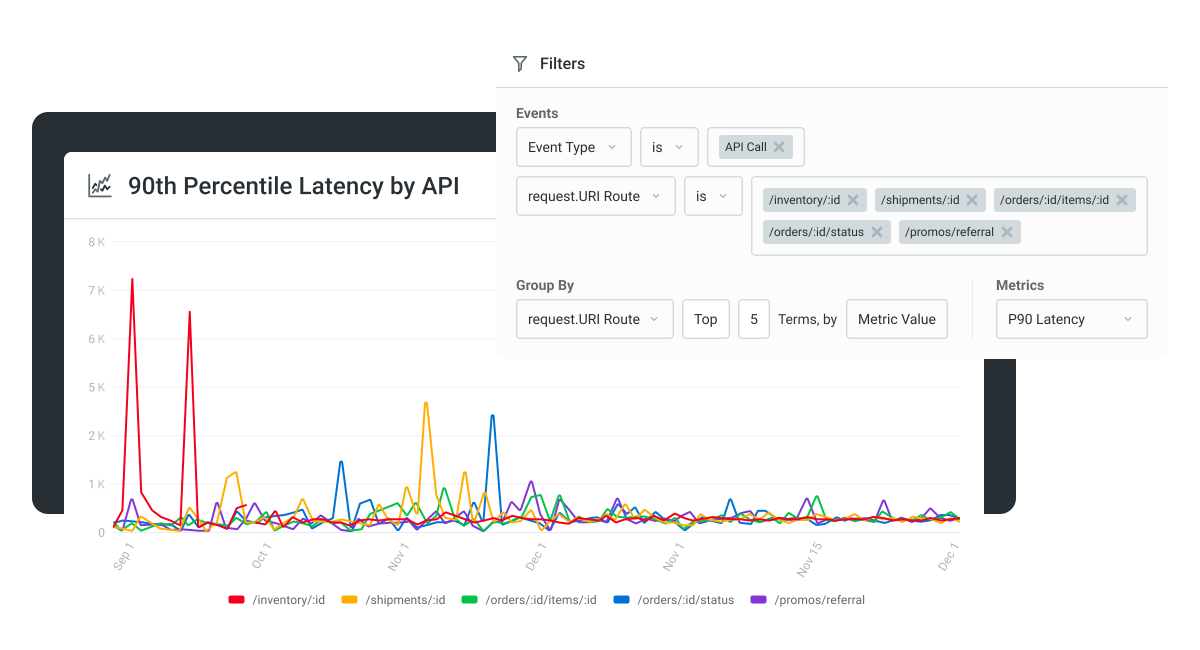
For monitoring APIs in production. Server-level metrics (Datadog, New Relic, Prometheus + Grafana) tell you whether the system is healthy. API-specific observability platforms (Moesif is purpose-built for this) tell you what your customers are actually doing on a per-endpoint, per-customer basis; the views you need to make product and business decisions rather than just operational ones.
For testing APIs. Postman includes a test runner; pytest with requests or httpx is the standard Python pattern; Jest with supertest is the standard JavaScript pattern. For contract testing (verifying the live implementation matches the spec), Schemathesis is the open-source standard.
For agent-facing APIs. If your API will be called by AI agents through MCP, the WSO2 AI Gateway auto-generates an MCP server from your OpenAPI spec. The same spec drives the REST surface for human developers and the MCP surface for agents, with no second build to maintain.
Most working developers in 2026 will touch the first three categories (explorer, OpenAPI tooling, SDK generation) regularly, the operational categories occasionally, and the agent-facing ones increasingly as MCP adoption grows.
How to use APIs as a developer (practical onboarding)
If you have never integrated an API before, the standard path from first sign-up to first successful call:
- Read the docs. Find the endpoint you want to call and the auth scheme it uses.
- Sign up. Create an account on the provider’s developer portal. Most are self-service and free for low volume.
- Get credentials. Generate an API key, or complete an OAuth flow to receive a token. Keep credentials out of version control.
- Make the first call. Most providers include a runnable
curlexample. Copy it, paste your key, run it. - Move into code. Install the language-specific SDK if one exists; otherwise use your language’s HTTP client (
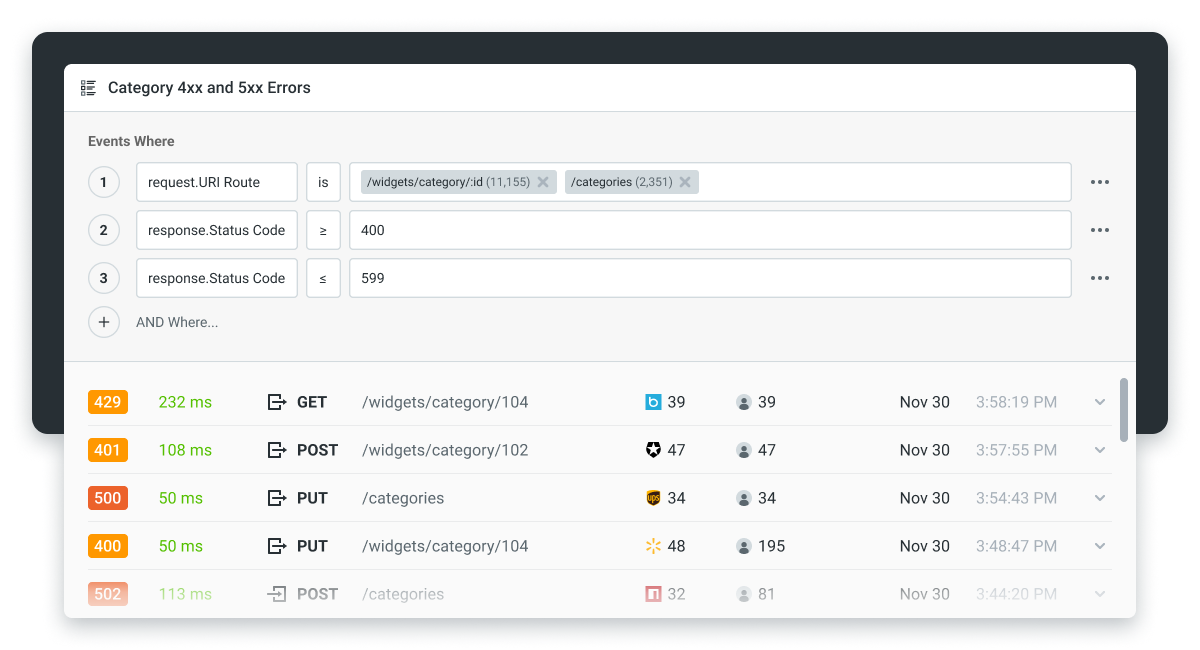
requestsin Python,fetchin JavaScript). - Handle errors. Check the status code. 2xx is success; 4xx means your request was wrong; 5xx means the server failed.
- Respect the rate limits. Most APIs publish a per-minute or per-hour ceiling. Build with backoff and retry from day one.
The patterns above are what every API onboarding looks like in 2026, regardless of provider. They are also the patterns that show up across our broader API design principles guide.
Next steps
The API acronym is shorthand for the contract that powers most of the modern internet. If you are about to build or consume one, start a 14-day Moesif free trial to see per-customer analytics on every API call from the day you ship. No credit card required.
Frequently asked questions
What does the acronym API stand for? Application Programming Interface. The Application is the software exposing the interface; Programming signals that the interface is for code, not humans; the Interface is the documented contract for asking and answering.
Is API a verb or a noun? A noun. People sometimes verb it informally (“we API’d into Stripe”), but in writing it stays a noun.
What does the acronym API stand for in Java? Same as everywhere: Application Programming Interface. In Java contexts the term often refers to the Java Class Library (the set of classes the JDK exposes), but the acronym’s meaning is unchanged.
Is API the same as a web service? A web service is an API delivered over HTTP. All web services are APIs; not all APIs are web services. The OS-level APIs in Windows and Linux are not web services.
Are all APIs free? No. Many APIs are free for low volume and paid above a quota. Some are paid from the first call (typically enterprise data or AI APIs). The acronym describes the interface, not the price model.
What is an API key? A long secret string an API issues to identify which customer is making the call. Most public APIs use API keys for server-to-server authentication; OAuth tokens are common for user-facing flows.
What is the difference between API and AI? API stands for Application Programming Interface, a contract between software components. AI stands for Artificial Intelligence, a category of computation. AI systems are often consumed through APIs (OpenAI’s API, Anthropic’s API), but the two acronyms refer to different things.

Related Articles

API Strategy
Leveraging AI For a Better API Strategy
Learn how to leverage AI to build and fortify your API strategy. Improve design, governance, documentation, and align APIs with business outcomes.
API Strategy
The 5 Best Mixpanel Alternatives of 2025
Learn about the best Mixpanel alternatives to determine the right analytics solution for your use case.

API Development
How to Leverage Moesif Effectively for API Observability
Effectively leverage Moesif for API observability through best practices for integration, event enrichment, custom actions, and engineering workflow integrat...
API Strategy
How to Build an Internal Chargeback Model for Your API and AI Usage Using Moesif
Use Moesif to implement internal chargebacks and enable precise API and AI cost attribution for better transparency and resource optimization.