API-First Approach: What It Is and How to Adopt It

An API-first approach is a development methodology where teams design the API contract, usually as an OpenAPI spec, before writing any application code, then build the implementation against that agreed contract. The payoff is parallel work across teams, a cleaner developer experience, and fewer expensive surprises late in the lifecycle.
That definition is short on purpose. The longer version, with examples, comparisons, and the steps to actually do it, is what the rest of this guide is for.
What is an API-first approach?
API-first treats the API itself as the product you ship, not as a side effect of shipping an application. Before the backend writes a controller, before the frontend writes a fetch call, somebody opens an editor and writes an OpenAPI document. That document describes every path, every request body, every response schema, every error. It gets reviewed by the people who will build against it. Only then does the code follow.
This sounds obvious, and yet most APIs in the wild are built code-first: a service grows, somebody bolts an HTTP layer on top, and the “spec” is whatever the framework happened to generate from the existing handlers. API-first inverts that order. The spec leads; the code follows.
API-first vs. API design-first
These two terms get used interchangeably, and most of the time that’s fine. Postman draws a useful distinction, though: API design-first focuses narrowly on writing the spec before the code, while API-first describes the broader organizational stance, APIs are products, they have owners, they have a lifecycle, and decisions about them rise above the level of a single team. If you’re a solo developer or a small team, you can be design-first without being fully API-first. The reverse is harder.
API-first vs. code-first
Code-first means the implementation comes first and the spec is generated from it, often after the fact. Tools like FastAPI or Springdoc make this easy: write your handlers, annotate your models, get a Swagger UI for free. The trade-off is that the spec becomes a downstream artifact. Any breaking change in the code immediately ships to clients. Reviewers don’t see the API until the implementation is already written.

Why teams adopt an API-first approach
The arguments for API-first land differently depending on who you ask. Here are the ones that actually move budget.
Parallel development across teams
Once the contract is agreed and frozen, the iOS team, the web team, and the backend team can all start work on Monday. The mobile engineers point their app at a mock server generated from the spec. The backend writes the real implementation. Nobody is blocked on anybody. In a code-first world, the mobile team waits for a sandbox environment, and that wait is usually weeks.
Better developer experience (DX)
API consumers, internal or external, get documentation, type-safe SDKs, and predictable error shapes from day one because all of those are generated from the same source of truth. Postman’s 2024 State of the API report flagged DX as the top differentiator for APIs that get adopted versus APIs that get ignored, and API-first is the cleanest path to delivering it.
Faster time to market
Fewer integration surprises means fewer re-plans. When a frontend team discovers in week 8 that the response shape doesn’t match what they assumed, you lose a sprint. Catching that mismatch at the spec review stage costs a 30-minute meeting.
Lower integration and rework costs
The cheapest bug to fix is the one caught during contract review. The next-cheapest is caught in mock testing. The most expensive is the one your enterprise customer reports after they’ve already integrated. API-first pushes detection left.
A foundation for AI agents and automation
This one is newer and worth dwelling on. LLM-powered agents, function calling in OpenAI, tool use in Claude, MCP servers, custom orchestrators, work by reading an API’s specification and deciding which calls to make. If you don’t have a clean, accurate, machine-readable spec, your APIs are effectively invisible to that whole category of consumer. Contentful’s 2025 update to their own API-first guide is one example of vendors flagging this shift, but the underlying point holds across the category: agents don’t read your marketing site, they read your OpenAPI document.
How API-first works in practice
The lifecycle has five concrete steps. The exact tooling varies, but the order doesn’t.
Step 1, Define the API contract
Open an editor. Write an OpenAPI 3.x document. Most teams use Stoplight, Redocly, or just a YAML file in a repo. The minimum viable spec for a single endpoint looks like this:
openapi: 3.1.0
info:
  title: Orders API
  version: 1.0.0
paths:
  /orders/{id}:
    get:
      summary: Get an order by ID
      parameters:
        - name: id
          in: path
          required: true
          schema:
            type: string
      responses:
        '200':
          description: OK
          content:
            application/json:
              schema:
                $ref: '#/components/schemas/Order'
        '404':
          description: Not found
components:
  schemas:
    Order:
      type: object
      required: [id, total, currency]
      properties:
        id: { type: string }
        total: { type: number }
        currency: { type: string, example: USD }
Two things to call out. First, components/schemas/Order is defined once and referenced from every operation that uses it, that’s how you keep the spec DRY. Second, the spec is detailed enough that a mock server can serve fake responses tomorrow morning, before any real code exists. For more on writing solid specs, see our guide to the API contract and our OpenAPI specification primer.
Step 2, Review and validate the contract
Treat the spec like you treat application code: pull request, reviewers, comments, approvals. The reviewers should include at least one consumer of the API, a frontend engineer, a partner team, an SDK author, not just the backend folks writing it. Lint the spec with Spectral or a similar tool to enforce house style rules (kebab-case paths, mandatory error responses, version prefixes).
Step 3, Generate mocks, stubs, and SDKs
This is where API-first stops feeling like overhead and starts paying back. From the OpenAPI document, you can generate:
- A mock server (Prism, Stoplight, Postman) that returns realistic responses immediately
- Client SDKs in a dozen languages (openapi-generator, Speakeasy, Fern)
- Interactive documentation (Redoc, Swagger UI, Mintlify)
- Type definitions for TypeScript, Go, Python
Frontend and partner teams work against the mock. Backend works against the contract. Both meet in the middle.
Step 4, Build the implementation against the contract
The backend team implements handlers that satisfy the spec. Contract testing tools (Dredd, Schemathesis) run the real implementation against the OpenAPI document and fail the build if the response shape, status codes, or error structure drift from what was agreed.
Step 5, Test, monitor, and iterate
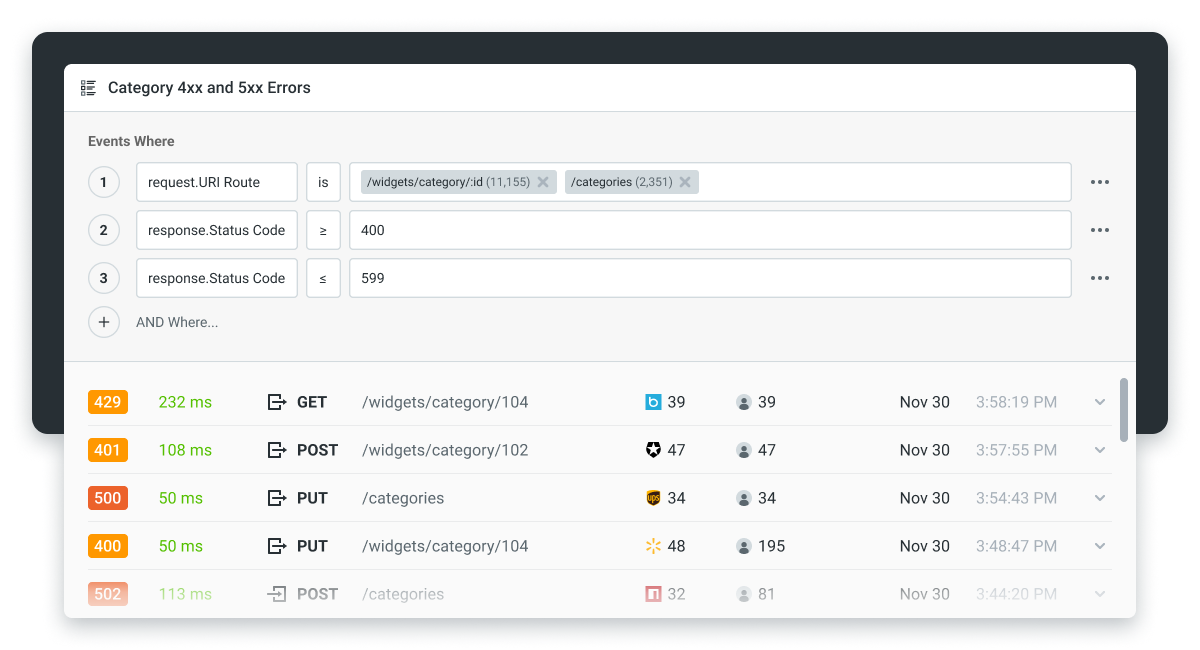
Ship it, then watch what actually happens. Which endpoints get called? Which return errors? Which customers are on deprecated versions? This is the step most teams treat as an afterthought, and it’s where Moesif lives, more on that below.
Diagram placeholder: API-first workflow vs. code-first workflow. Side-by-side flowchart. API-first column: Define spec → Review → Mock + Generate SDKs → Build implementation (parallel: frontend builds against mock) → Contract test → Deploy → Observe. Code-first column: Build implementation → Generate spec from code → Document → Frontend integrates → Discover mismatches → Refactor → Re-document.
API-first vs. other approaches
The four terms below get mixed together a lot. Here’s how they actually differ.
| Approach | When you design | Primary artifact | Best for | Trade-offs |
|---|---|---|---|---|
| API-first | Before any code | OpenAPI spec, agreed across teams | Multi-team orgs, public APIs, platform plays | Upfront design cost; needs cultural buy-in |
| Code-first | Implementation drives the design | Generated spec (derived from handlers) | Small teams, internal services, rapid prototypes where shipping speed matters most | Spec can drift from implementation; breaking changes are easier to introduce without review |
| Design-first | Spec first, but at one team’s level | OpenAPI spec | Single product teams shipping quickly | No org-level governance; APIs as products is implicit |
| Contract-first | Before code, often with consumer contracts (Pact) | Consumer-driven contracts | Microservices with many consumers | Tooling overhead; CDC discipline required |
API-first is the umbrella; design-first and contract-first sit underneath it. Code-first is a different philosophy with its own trade-offs, faster early on, harder to govern as the surface grows. If you want a deeper read on the contract-first variant, our piece on contract-first API development covers it in depth.
Common challenges (and how to handle them)
Nothing here is a deal-breaker. All of them are predictable.
Cultural resistance from backend-first teams
Engineers who built their careers shipping code resent being asked to “write YAML for a week” before they can open their IDE. The fix isn’t to argue, it’s to show the receipts. Track the rework rate on your last three integration projects. Compare to the first API-first project. The numbers usually argue better than you can.
Keeping the contract and implementation in sync (drift)
The spec says the field is called customer_id. Someone refactors the handler and renames it to customerId. The spec doesn’t get updated. Three weeks later, a partner integration breaks. The defense is automated contract testing in CI: every build runs the implementation against the spec, and any divergence fails the pipeline. Schemathesis is the go-to open-source option; commercial tools like Stoplight and Optic do the same thing with prettier dashboards.
Governance at scale
One team writing OpenAPI is fine. Forty teams writing OpenAPI is chaos unless someone owns the rules, naming conventions, versioning policy, error envelope, auth pattern. Most large API programs land on some version of an API council or platform team that maintains a style guide and a Spectral ruleset. Our guide to API governance walks through how to set this up without bureaucracy.
Best practices for adopting API-first
A short list, in rough order of impact:
- Pick one spec format and one style guide. OpenAPI 3.1 plus a Spectral ruleset is the default for a reason. Don’t let teams roll their own.
- Version from day one.
/v1/orders, not/orders. Future-you will thank present-you. - Standardize your error envelope. Same shape every time. Same status code semantics. RFC 7807 (Problem Details) is a reasonable starting point.
- Mock before you build. If frontend can’t integrate against a mock the day after the spec is approved, your spec isn’t detailed enough.
- Automate contract tests in CI. No exceptions, no “we’ll add it later.”
- Make the spec a first-class artifact in the repo. Not in a wiki. Not in a Google Doc. In the same repo as the code, reviewed in the same PRs.
- Instrument from launch, not after the first outage. You need to know which endpoints are used, by whom, and how often. See the Moesif section below.
For a broader treatment of design fundamentals, naming, pagination, idempotency, pagination, our good API design principles post covers the territory.
How Moesif fits into an API-first workflow
API-first gets you to a shipped contract. It doesn’t tell you what happens after that. Once your API is live, the questions shift: which endpoints are people actually calling? Which customers are still on the deprecated v1? Is the production behavior matching the spec, or has implementation drift crept in? Are the partners you onboarded last quarter hitting the volume thresholds in their contracts?
That’s where Moesif comes in. We provide API analytics, observability, and monetization for teams that treat their API as a product:
- Per-customer and per-endpoint usage analytics. Slice traffic by user, organization, plan, or any custom dimension. See which endpoints have product-market fit and which are dead weight.
- OpenAPI ingest. We import your spec and track compliance, if the live API starts returning fields that aren’t in the contract, you’ll see it.
- Usage-based billing. Meter calls, payload bytes, or whatever dimension your pricing model uses, and push it to Stripe or your billing system.
- Alerts on schema drift and anomalies. Get paged when a deploy starts returning new status codes or when an enterprise customer’s error rate spikes.
For an API-first team, we close the lifecycle: spec → build → ship → observe → iterate on the spec again.
API-first FAQ
What is the API-first principle? The principle is that the API contract is the most important artifact in your project, more important than any individual application, frontend, or backend that consumes it. Everything else is designed to satisfy the contract; the contract is not designed to satisfy whatever the code already does.
What is an API-first integration strategy? An integration strategy is API-first when every system the company connects, internal services, partner integrations, SaaS connectors, is treated as an API consumer that gets a stable, documented, versioned interface. The alternative is point-to-point integration, where every new connection is a custom project.
What is a code-first approach in Web API development? Code-first means you write the implementation in your web framework first (ASP.NET, Express, FastAPI, Spring) and let the framework generate the spec from your code. It’s faster for small projects and harder to govern as the API surface grows.
Is API-first the same as API design-first? Mostly yes, sometimes no. Both put the spec before the code. API-first is broader, it also implies APIs are organizational products with owners, contracts, and lifecycle management. Design-first is the narrower technical practice. In casual usage, the two are interchangeable.
Which tools do I need to go API-first? A spec editor (Stoplight, Redocly, or just VS Code with an OpenAPI extension), a linter (Spectral), a mock server (Prism), an SDK generator (openapi-generator or Speakeasy), a contract test runner (Schemathesis or Dredd), and an observability layer (Moesif). You don’t need all of them on day one, start with the editor and the linter.
Last updated: May 25, 2026. Written by Preet Kaur, Developer Advocate at Moesif, who has spent the last five years helping API teams ship contracts they can defend in production.

Related Articles

API Strategy
Leveraging AI For a Better API Strategy
Learn how to leverage AI to build and fortify your API strategy. Improve design, governance, documentation, and align APIs with business outcomes.
API Strategy
The 5 Best Mixpanel Alternatives of 2025
Learn about the best Mixpanel alternatives to determine the right analytics solution for your use case.

API Development
How to Leverage Moesif Effectively for API Observability
Effectively leverage Moesif for API observability through best practices for integration, event enrichment, custom actions, and engineering workflow integrat...
API Strategy
How to Build an Internal Chargeback Model for Your API and AI Usage Using Moesif
Use Moesif to implement internal chargebacks and enable precise API and AI cost attribution for better transparency and resource optimization.