What Is Open API? Definition, Examples & Best Practices
An open API is an API that any developer can use without applying for special access. If you have ever signed up for a Stripe or Twilio account, grabbed an API key, and started making requests within an hour, you have used an open API. The phrase covers a wide range, from fully public weather APIs to commercial APIs gated behind a free tier, but they all share one trait: there is a documented public path from “outside developer” to “first successful call.”

This guide walks through what makes an API open, how the term relates to the OpenAPI Specification (which is not the same thing), what open APIs look like in production, and how to design and govern one in 2026.
What is an open API?
An open API (sometimes called a public API or external API) is an API that a service exposes to developers outside the company that built it. The contract is published, the authentication is self-service, and the endpoints behave the same way for every consumer.
Three things distinguish an open API from a private one:
- Public documentation. Anyone can read the spec, request/response shapes, and code examples without an NDA or sales call.
- Self-service onboarding. A developer can register, get credentials, and make a first call without human intervention.
- A stable contract. Breaking changes get versioned and announced in advance, because the customer base is large and unknown.
Open APIs are how Stripe, Twilio, OpenAI, GitHub, and most of the modern internet expose their products to other companies. They are also how banks expose account data under Open Banking regulation, and how government datasets reach civic-tech developers.
Open API vs. OpenAPI Specification: clearing the confusion
The two terms sound identical and people use them interchangeably, but they refer to different things.
- Open API (two words) is a category of API, one that is publicly accessible.
- OpenAPI Specification (one word, sometimes “OAS”) is a file format for describing any HTTP API in a machine-readable way. It is maintained by the OpenAPI Initiative under the Linux Foundation. A spec is usually written in YAML or JSON.
You can have one without the other. A private internal API can use the OpenAPI Specification to document its endpoints. A public open API does not have to use OpenAPI; some still ship hand-written REST docs or rely on GraphQL introspection.
In practice, most new open APIs do use the OpenAPI Specification, because the spec makes it easy to auto-generate docs, client SDKs, and (in 2026) MCP servers for AI-agent consumption.
How an open API works in practice
Most open APIs follow the same shape from a developer’s perspective:
- Sign up. Visit the provider’s developer portal, create an account, agree to the terms of service.
- Get credentials. The portal issues an API key or starts an OAuth flow to issue a token.
- Read the docs. Find the endpoint you need, the request shape, and the auth header pattern.
- Make the first call. Usually a
curlor fetch example you can copy and paste, with your key dropped in. - Move into production. Once the integration works, the developer’s traffic ramps up against the same endpoints, just with higher volume.
Behind the scenes, the provider is doing significant work to keep those endpoints stable: an API gateway is enforcing auth and rate limits, a versioning policy is protecting old clients, and an observability layer is recording who called what.
Open API vs. closed (private) API
The opposite of an open API is a closed or private API: one only available to consumers inside the organization, or to a small set of named partners under contract.
The main differences:
| Open API | Closed API | |
|---|---|---|
| Audience | Any external developer | Internal teams or named partners |
| Documentation | Public, indexed by search | Internal wiki or partner portal |
| Onboarding | Self-service (sign up, get key) | Human-mediated (account managers) |
| Rate limiting | Required, applied per customer | Optional, often unenforced |
| Versioning policy | Public deprecation calendar | Coordinated with consumers directly |
| Threat surface | Internet-wide | Internal network or VPN |
The two often coexist inside one company. Stripe’s open API is what developers integrate with; their internal admin APIs are closed. Both can use the same gateway and observability stack.
Real-world examples of open APIs
A few patterns to recognize:
- Payment APIs: Stripe, Adyen, Square. The dominant pricing model is revenue share.
- Communication APIs: Twilio, Vonage, Plivo. Usage-based pricing, billed per call or message.
- AI APIs: OpenAI, Anthropic, Google Gemini. Token-based pricing with cached-input discounts.
- Developer infrastructure: GitHub API, Vercel API, Cloudflare API. Often free for low volume, paid above quota.
- Open Banking APIs: Plaid, Tink, regulated bank-to-fintech APIs in the EU and UK.
- Social and content platforms: Reddit, YouTube, Spotify. Mostly read-only for free tiers, write access on commercial plans.
Each model uses a different pricing approach (transaction volume, token volume, revenue share, subscription tiers) but they all share the open-API onboarding pattern above.
Benefits of open APIs
For the company exposing the API:
- Distribution beyond your direct customers. Every developer who builds on your API becomes a distribution channel.
- Faster integration with partners. Self-service onboarding compresses what used to be six-month BD cycles into one afternoon.
- A market signal for what to build next. Usage patterns across thousands of integrations are the most honest product feedback you will ever get.
For the developer consuming it:
- Speed. Skip building from scratch when an existing service already does the job.
- Specialization. Use the best provider for each capability (payments, comms, search, ML) without picking a single vertical SaaS.
- A common contract. REST and OpenAPI conventions mean a developer who has used one API can usually pick up another in a few hours.
Security and governance challenges
The flip side of being publicly accessible: every endpoint is reachable from the internet, and every endpoint can be attacked.
The non-negotiables for any open API in 2026:
- TLS 1.2 or higher on every endpoint. No exceptions, even for “internal” surfaces that briefly touch public DNS.
- Per-customer authentication. API keys or OAuth tokens, with the ability to revoke a single customer without rotating credentials for everyone.
- Per-customer rate limiting. Without it, one badly-behaved integration takes down the API for the rest of your customers.
- Schema validation at the gateway. Reject malformed requests before they reach your business logic.
- Audit logging. Every call attributed to a customer, retained long enough to support incident investigations.
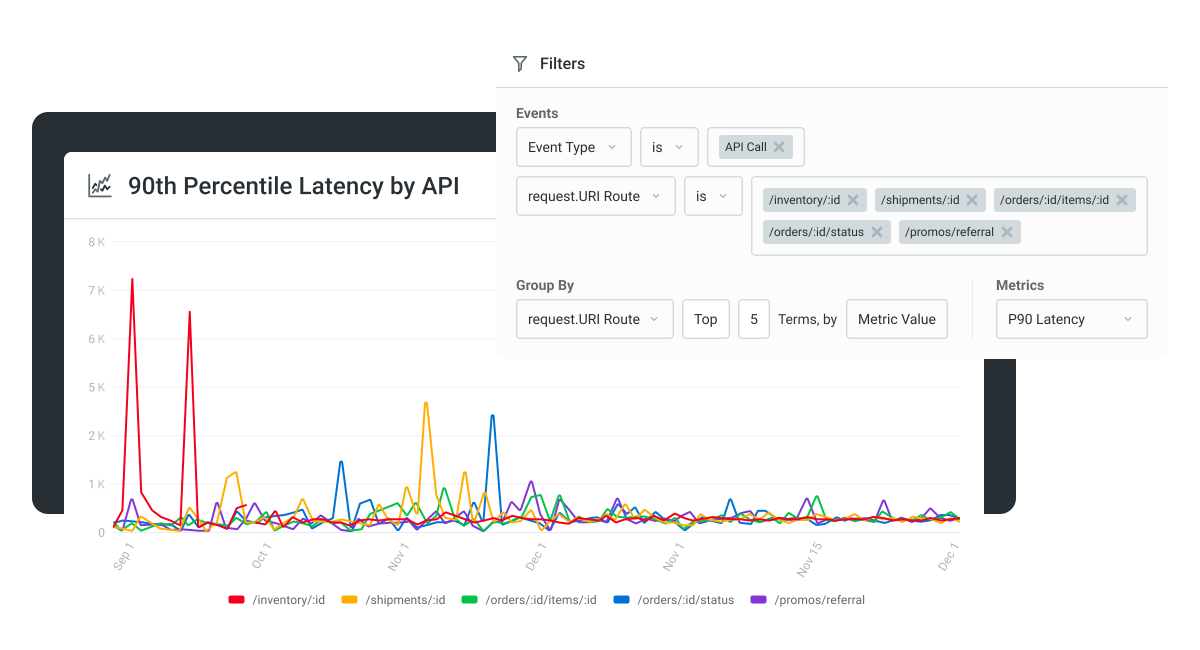
The observability layer that makes this possible is the one you reach for after the gateway has done its work. Moesif API monitoring gives per-endpoint, per-customer, payload-level visibility across any gateway, including the WSO2 API Manager, Kong, AWS API Gateway, Azure APIM, and Envoy. When a customer reports a problem, the path from their support ticket to the specific request that failed is one query, not a half-day of log diving.
Monetizing and analyzing open API traffic
Once an open API is live and authenticated traffic is flowing, the next questions are about turning that traffic into either business outcomes (revenue, expansion, retention) or operational insight (which integrations are growing, which are stalling, which are at risk).
The patterns that compound:
Per-customer usage attribution is the foundation. Every call must be tagged with the customer it came from at the gateway layer, before the request hits any backend service. Without per-customer attribution, every downstream analytics and billing decision is impossible.
Pricing decisions follow usage shape. Tiered subscriptions work for predictable consumers; per-call (or per-token, per-agent-invocation) usage-based pricing works for variable consumers and AI-mediated traffic. The unit of value is the call’s business outcome, not the call itself. Our API pricing guide covers the trade-offs in depth.
Engagement metrics that matter. Daily/weekly/monthly active customers, time-to-first-call, time-to-100-calls, calls per customer, error rate per customer, endpoint adoption per customer. These tell you which customers are growing, which are stalling, and where the product team should invest.
Anomaly detection on usage shape. Sudden spikes (10x traffic from one customer, a new IP range hitting auth endpoints, an unusual error pattern) need to be visible without waiting for an incident. Open APIs are public surfaces, so the abuse vectors are real.
Cost attribution for downstream services. If your open API calls third-party services (LLM providers, payment processors, identity services), those costs need to be attributable back to the customer that drove them. Otherwise the unit economics get opaque.
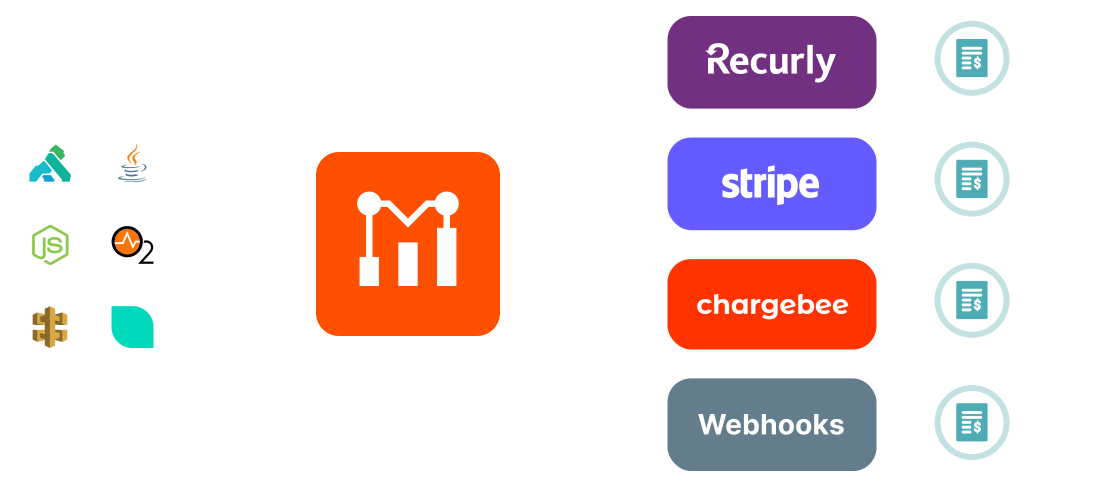
The tool that integrates with every major gateway and covers these patterns out of the box is the API-specific observability and monetization layer (Moesif in this stack). It instruments the WSO2 API Manager, Kong, AWS API Gateway, Azure APIM, and Envoy through middleware, and presents the data in views built around customer behavior rather than infrastructure health.
How to design and manage an open API in 2026
The short version of our nine API design principles, adapted for open APIs specifically:
- OpenAPI-first. Write the spec, generate the server stub and docs from it. Keeps documentation honest by construction.
- Resource-oriented URLs. Plural nouns for collections, predictable nesting, no
/createUserendpoints. - Versioning policy in writing. State, on your public site, how much notice you give before removing a version. Twelve months is the standard for paid open APIs.
- Idempotency keys on writes. Public APIs get retried by clients you cannot audit. Make retries safe.
- Generous error responses. Return an error code, a human-readable message, and the field that failed validation, on a
4xxstatus. The developer trying to integrate is your customer. - Pagination, filtering, and sorting that work the same way on every list endpoint.
- A changelog page that is actually maintained.
- Per-customer observability from day one. If you cannot answer “which customer is currently hitting
/v1/charges?” your support team will burn out by month six.
At enterprise scale, the design-to-runtime governance question is what platforms like the WSO2 API Platform solve. WSO2 API Manager enforces governance policies against the OpenAPI spec automatically (naming rules, required security minimums, deprecation policies), and the WSO2 AI Gateway turns those same APIs into MCP-compatible servers for AI-agent consumers without a separate build.
Where to take this next
An open API is more than a documentation page. It is a contract you keep with developers who chose your service over your competitors, and it lives or dies on the design, security, and observability behind it.
Start a 14-day Moesif free trial to see per-customer usage on your open API within an hour. No credit card required.
Frequently asked questions
Is the OpenAPI Specification the same as Swagger? They share history. Swagger was the original name of the specification before it was donated to the Linux Foundation and renamed the OpenAPI Specification in 2016. Swagger now refers to the set of tooling (Swagger UI, Swagger Editor, Swagger Codegen) maintained by SmartBear that consumes OpenAPI documents. The spec itself is OpenAPI.
Are open APIs free? Some are; most commercial open APIs are free for low volume and paid above a quota. “Open” refers to accessibility, not price. An open API can charge.
Do open APIs need authentication? Almost always. A small set of fully public APIs (like some government datasets) do not require credentials, but any open API that performs writes, accesses customer data, or has a cost to serve will require an API key or OAuth token.
What is the difference between REST API and open API? REST is an architectural style for designing APIs; open describes the accessibility of the API. A REST API can be open or closed; an open API can be REST, GraphQL, or RPC.
Can you monetize an open API? Yes, and most successful public APIs do. The dominant models are pay-as-you-go (Twilio, OpenAI), tiered subscription (most SaaS APIs), and revenue share (Stripe). Choosing among them is its own discipline.

Related Articles

API Strategy
Leveraging AI For a Better API Strategy
Learn how to leverage AI to build and fortify your API strategy. Improve design, governance, documentation, and align APIs with business outcomes.
API Strategy
The 5 Best Mixpanel Alternatives of 2025
Learn about the best Mixpanel alternatives to determine the right analytics solution for your use case.

API Development
How to Leverage Moesif Effectively for API Observability
Effectively leverage Moesif for API observability through best practices for integration, event enrichment, custom actions, and engineering workflow integrat...
API Strategy
How to Build an Internal Chargeback Model for Your API and AI Usage Using Moesif
Use Moesif to implement internal chargebacks and enable precise API and AI cost attribution for better transparency and resource optimization.