Apigee API Gateway: Features, Pricing, and Alternatives (2026)
Apigee is Google Cloud’s enterprise API management platform. It is one of three or four products in the category that consistently shows up on shortlists when an enterprise team is choosing how to expose, govern, and monetize APIs at scale, alongside MuleSoft, Kong, IBM API Connect, and the WSO2 API Platform. If you have arrived here, you are probably evaluating Apigee against one of those alternatives, looking up a specific Apigee feature, or trying to understand what changed since the “Apigee X” and “Apigee Edge” naming days.

This guide covers what Apigee is in 2026, what it does well, where it can be a tough fit, what it costs, and how it compares to the other main choices. Most of the facts below come straight from Google Cloud’s own Apigee product page; we have cited the pricing and capability claims so you can verify them.
What is Apigee API Gateway?
Apigee is a fully managed API management platform from Google Cloud. It sits in front of your backend services as an API proxy layer, enforcing security, rate limiting, transformation, and analytics. Per Google Cloud’s product page, Apigee supports REST, SOAP, GraphQL, and gRPC architectural styles, and ships in three deployment shapes: fully managed (the default), Apigee hybrid (your own Kubernetes cluster), and Cloud Endpoints / API Gateway (lighter Google Cloud-native gateways for simpler use cases).
People sometimes use “Apigee API Gateway” to mean only the proxy layer, but in practice Apigee is the broader platform: gateway, developer portal, analytics, monetization, security, and (newer in 2026) AI-assisted spec generation through Gemini Code Assist.
Apigee in 2026 vs. legacy Apigee Edge: which one are people using now
If you read older articles about Apigee, you will see two product names that no longer separate the way they used to.
- Apigee Edge was the legacy on-prem-friendly version. It is in long-term support; no new deployments default to it.
- Apigee X was the cloud-native version that runs alongside Edge. Google’s marketing pages now refer to the platform simply as “Apigee,” although “Apigee X” still appears in Google Cloud documentation and release notes as the canonical product name.
In 2026, the practical lineup is:
- Apigee (the managed Google Cloud service) for most enterprise use cases
- Apigee hybrid for teams that need to run the gateway in their own Kubernetes cluster
- Cloud Endpoints for gRPC and private-network use cases
- API Gateway (Google Cloud’s lighter product) for packaging serverless functions as REST APIs
If you read a blog post that talks about “Apigee X” or compares “Apigee Edge vs Apigee X,” it is describing the same transition that is still being worked through across documentation and the customer base; the current product on Google Cloud is just labeled Apigee in marketing material, but the underlying runtime is still the one historically called Apigee X.
Core features of Apigee
Per Google Cloud’s documentation, the platform includes:
- API proxies that front backend services with policies for security, rate limiting, quotas, and transformation.
- Multi-protocol support: REST, SOAP, GraphQL, gRPC.
- Advanced API Security with ML-powered abuse detection, automated configuration checks, and integration with Google Cloud’s WAAP (Web App and API Protection, combining Apigee, Cloud Armor, and reCAPTCHA Enterprise).
- Developer portal for publishing APIs, managing API keys, and onboarding external developers.
- Monetization with rate plans, billing models, and revenue tracking.
- Analytics dashboards showing traffic, latency, and error patterns.
- Gemini Code Assist in Apigee for AI-assisted OpenAPI spec generation and proactive duplicate-API detection.
- API hub, a universal catalog of APIs (built or deployed anywhere) that consolidates discovery and governance.
- Apigee hybrid for deploying the runtime in your own Kubernetes cluster while keeping a managed control plane.
This is a broad surface. Apigee covers the full API lifecycle from design through observability, which is part of why it appears on enterprise shortlists.
What Apigee is good at
A few capabilities Apigee covers, with the caveat that several alternatives (notably WSO2) cover the same ground.
Google Cloud-native integration. If your platform team already runs on Google Cloud, Apigee plugs into Cloud Armor, Identity-Aware Proxy, BigQuery, and the rest of GCP’s services without much glue work. The WAAP combination (Apigee + Cloud Armor + reCAPTCHA) is specific to Google Cloud and not portable to other clouds.
Scale on Google’s infrastructure. Apigee is used by large enterprises on Google Cloud. The fully managed offering inherits GCP’s infrastructure characteristics. WSO2 and the major alternatives also operate at enterprise scale; the difference is which cloud the runtime lives on.
Multi-protocol support. Apigee handles REST, SOAP, GraphQL, and gRPC, which matters in legacy-heavy environments running SOAP next to modern REST. WSO2 and several other full-platform competitors also cover the same protocol set; Apigee is not unique on this dimension.
Developer portal and monetization. The portal and monetization features support rate plans, quotas, and revenue tracking out of the box. Apigee is one of several platforms that covers the publishing-to-revenue loop; WSO2 + Moesif covers the same loop with a more open-source-leaning stack.
Recent AI integrations. Gemini Code Assist in Apigee generates OpenAPI specs from natural language and flags duplicate APIs. The competitive landscape on AI features is moving quickly: WSO2’s AI Gateway auto-generates MCP servers from any OpenAPI spec and governs both inbound agent and outbound LLM traffic natively; Kong has an AI Gateway plugin set; Apigee’s strength is the integration with Google’s Gemini stack specifically.
Where Apigee can be a tough fit
Where to be careful when shortlisting Apigee.
Pricing complexity. Apigee’s pricing has multiple axes (per-call, per-environment, per-deployment, plus add-ons) and the pay-as-you-go bill at scale can surprise teams used to flat-rate pricing. The Standard / Enterprise / Enterprise Plus subscription tiers exist for predictability, but they require a sales conversation.
Google Cloud gravity. Apigee runs on Google Cloud. Apigee hybrid mitigates this by letting you run the data plane elsewhere, but the control plane and most integrations still assume GCP. If you are committed to AWS or Azure as your primary cloud, the integration depth is asymmetric.
Migration cost from Apigee Edge. Teams still on the legacy Apigee Edge are looking at a non-trivial migration to current Apigee. Google has documented the path, but it is work.
Operational learning curve. Apigee is comprehensive, which means a lot to learn. Smaller teams that want a simpler API gateway sometimes find Apigee heavier than the use case requires.
Apigee pricing in 2026
Per Google Cloud’s pricing page (current as of May 2026), the headline structure:
- Evaluation: 60-day free sandbox.
- Pay-as-you-go:
- API calls starting at $20 per 1M API calls (up to 50M calls per month).
- $365 per month per deployment environment, per region (entry tier).
- Per-hour charges for additional proxy deployments in comprehensive environments (rates vary by tier and region).
- Add-ons: API Analytics and Advanced API Security at starting prices of $20 per 1M API calls.
- Subscription tiers: Standard, Enterprise, and Enterprise Plus, sold via Google Cloud sales.
These are list prices; enterprise customers usually negotiate. Verify the latest figures from Google Cloud’s pricing page before budgeting, because the pricing model has shifted twice in the last three years.
How Apigee compares to other API gateways
The realistic shortlist when evaluating Apigee in 2026:
- WSO2 API Platform. Apache 2.0 open-source core, multi-cloud and on-prem deployment, full-lifecycle coverage across gateway, governance, portal, analytics, and monetization. Multi-gateway runtime (deploys across WSO2, Kong, AWS, Azure, and Envoy from one control plane). Native AI Gateway that auto-generates MCP servers from any OpenAPI spec and governs inbound agent + outbound LLM traffic. Named a Leader in The Forrester Wave: API Management Software, Q3 2024.
- MuleSoft Anypoint Platform (Salesforce). Closest to Apigee in scope. Positioned more around iPaaS/integration than pure API monetization. Enterprise pricing model.
- Kong (Kong Gateway / Kong Konnect). Lightweight, plugin-driven gateway. Common in Kubernetes-native environments. Lighter on lifecycle management, governance, and monetization than full platforms.
- AWS API Gateway. AWS-native. Fits when the team is fully on AWS. Limited developer portal and monetization features; multi-cloud not supported.
- Azure API Management (APIM). Microsoft-native equivalent. Fits when the platform lives on Azure. Pricing tiers are layered and analytics depth is lighter than the larger platforms.
- IBM API Connect. Vendor-fit for enterprises already in the IBM software estate. Slower release cadence than cloud-native platforms.
There is no universal winner. The right choice depends on which cloud you are already on, whether you need multi-cloud or on-prem deployment, and how much of the platform you want pre-built versus assembled.
When to choose Apigee, and when to look at alternatives
Apigee is a reasonable fit when:
- You are already committed to Google Cloud at meaningful scale.
- You need multi-protocol support (REST + SOAP + GraphQL + gRPC) under one platform.
- You want AI-assisted spec generation specifically tied to Google’s Gemini stack.
- Your monetization needs include rate plans and developer portals out of the box.
- You can absorb the operational and pricing commitment.
Look harder at alternatives when:
- Your primary cloud is AWS or Azure (look at API Gateway/APIM or a multi-cloud platform).
- You need on-prem or air-gapped deployment with full open-source license access (look at WSO2 or Kong).
- You want a simpler, more developer-centric gateway (look at Kong or Tyk).
- Pricing predictability matters more than feature breadth (compare Apigee subscription tiers against alternatives’ flat-rate offerings carefully).
The WSO2 API Platform is the alternative we know best because Moesif is part of it. WSO2 covers the same lifecycle stages as Apigee with a different deployment model (fully open-source-rooted, multi-cloud, with the AI Gateway covering inbound MCP and outbound LLM traffic). Whether it is the right answer for you depends on the same criteria above; we recommend evaluating both honestly if you are deciding between them.
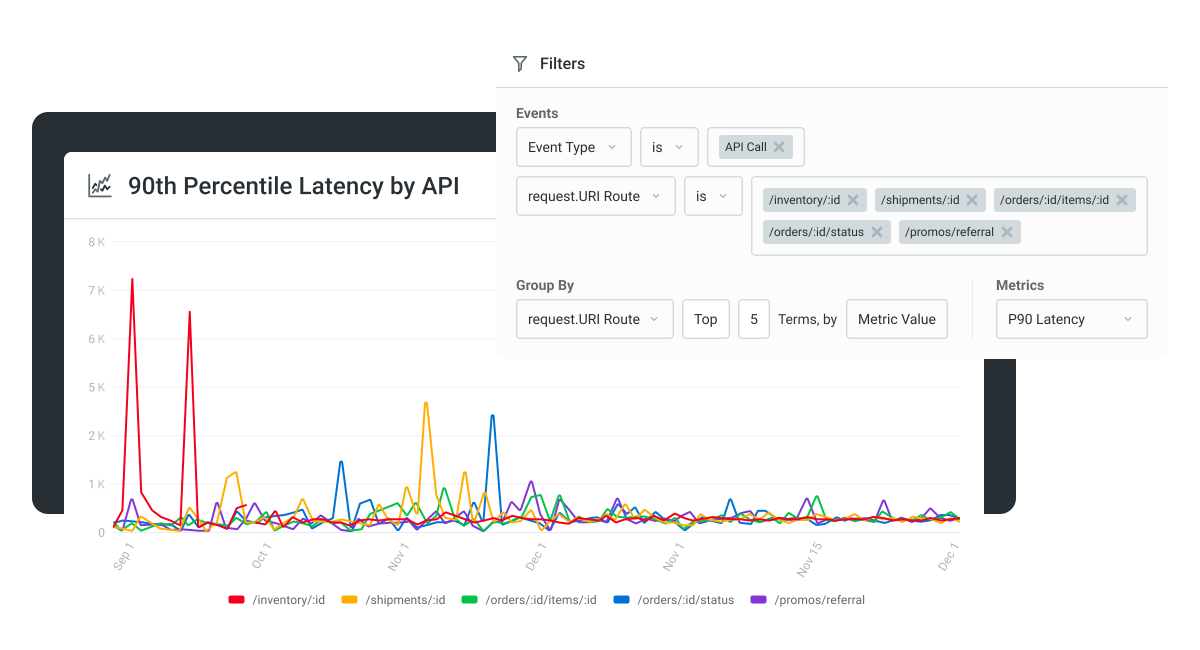
For the observability slice, regardless of which gateway you choose, Moesif API monitoring works behind any of the gateways above (Apigee, WSO2, Kong, AWS, Azure, Envoy) and provides per-customer, per-endpoint, payload-level analytics that the gateway’s built-in dashboards typically do not.
Where to take this next
Apigee is a credible enterprise choice when the Google Cloud fit is right. If you are still evaluating, the practical next step is to read each shortlist platform’s own product page, run a proof of concept on a small API, and watch what your actual customers do once you deploy.
Once your gateway is in place, observability is the layer that closes the loop between platform decisions and customer outcomes. Start a 14-day Moesif free trial to add per-endpoint, per-customer analytics behind Apigee or any other gateway. No credit card required.
Frequently asked questions
What is the difference between Apigee and an API gateway? Apigee is a platform that includes an API gateway alongside a developer portal, analytics, monetization, and lifecycle management. A bare API gateway is just the runtime that proxies and enforces policies on API calls. Apigee is the larger platform.
Is Apigee free? Apigee offers a 60-day evaluation sandbox at no cost. Production usage starts at $20 per 1M API calls and $365 per month per environment, plus add-ons.
Is “Apigee X” still a current product name? Mixed. Google’s marketing pages refer to the platform simply as “Apigee,” but “Apigee X” still appears in Google Cloud documentation and release notes as the canonical product name distinguishing the cloud-native runtime from the legacy “Apigee Edge” SaaS. Both names are still in active use; just the marketing surface has been simplified.
Does Apigee support GraphQL and gRPC? Yes. Apigee supports REST, SOAP, GraphQL, and gRPC per Google Cloud’s product page.
Can I run Apigee on AWS or Azure? Apigee itself runs on Google Cloud. Apigee hybrid lets you run the data plane (the actual gateway proxies) in your own Kubernetes cluster on any cloud, while the control plane stays on Google Cloud.
What are the main alternatives to Apigee? MuleSoft Anypoint, Kong, AWS API Gateway, Azure API Management, IBM API Connect, and the WSO2 API Platform are the platforms that show up most often on the same shortlist.

Related Articles

API Strategy
Leveraging AI For a Better API Strategy
Learn how to leverage AI to build and fortify your API strategy. Improve design, governance, documentation, and align APIs with business outcomes.
API Strategy
The 5 Best Mixpanel Alternatives of 2025
Learn about the best Mixpanel alternatives to determine the right analytics solution for your use case.

API Development
How to Leverage Moesif Effectively for API Observability
Effectively leverage Moesif for API observability through best practices for integration, event enrichment, custom actions, and engineering workflow integrat...
API Strategy
How to Build an Internal Chargeback Model for Your API and AI Usage Using Moesif
Use Moesif to implement internal chargebacks and enable precise API and AI cost attribution for better transparency and resource optimization.