API Development: The 2026 Practitioner’s Guide
If you are shipping a new API in 2026, the work is no longer just writing route handlers. You are picking a framework that handles async cleanly, designing a contract that AI agents can consume through MCP, planning a deprecation policy before the API has any users, and choosing an observability stack that attributes every call back to a customer. The decisions you make in the first week shape every quarter that follows.

This guide walks through the seven stages of modern API development, what to choose at each stage, the mistakes that bite the most, and how to keep the lifecycle coherent once your API is in production. It is the practitioner’s version, not a textbook overview.
What API development actually means in 2026
API development is the process of designing, building, governing, deploying, and operating an API across its full lifecycle. The phrase covers the technical work (spec, code, tests) and the platform work (governance, security, observability, monetization) that turn a working endpoint into a product real customers integrate against.
The 2026 wrinkle: APIs are no longer consumed only by human developers. AI agents now consume APIs through the Model Context Protocol (MCP). LLM applications call APIs as part of multi-step reasoning. That changes some of the foundational decisions about idempotency, versioning, and observability.
The seven-stage API development workflow
| # | Stage | Primary owner | Output |
|---|---|---|---|
| 1 | Identify the consumer and the value | Product + Platform | One-page brief: who, why, how measured |
| 2 | Design the contract (OpenAPI-first) | Engineering + Architecture | OpenAPI spec |
| 3 | Build the implementation | Engineering | Working API server |
| 4 | Test | QA + Engineering | Unit + integration + contract tests passing |
| 5 | Govern and secure | Platform team | Approved spec, security review, rate limits |
| 6 | Deploy and publish | Platform + DevOps | Live endpoint + developer portal listing |
| 7 | Observe and iterate | Platform + Product | Live analytics, deprecation calendar |
Stages overlap in practice. A v2 endpoint can be in stage 3 while v1 is in stage 7. The framework helps a team know what they own at each moment. We cover the lifecycle in detail in our API lifecycle guide; this post focuses on the development slice.
Stage 1: Identify the consumer and the value
Three questions, answered before any code:
- Who is the consumer? External developers integrating commercially, internal teams, AI agents through MCP, or some mix?
- What outcome does this API enable? “Customers can settle invoices programmatically” beats “we expose a payments endpoint.”
- What is the success metric? Integrations shipped per quarter, agent calls per month, revenue from consumption, ticket reduction. Without a metric, you cannot tell stage 7 whether the API is working.
Stage 2: Design the contract
Modern API development is OpenAPI-first. You write the spec before any server code. The spec generates server stubs, client SDKs, and documentation by construction, which keeps the three artifacts in sync.
The design decisions worth making deliberately here:
- Resource model that matches the consumer’s mental model, not your database schema
- Pagination, filtering, and sorting that work the same on every list endpoint
- Versioning policy in writing (URI vs header; how long deprecated versions stay live)
- Idempotency keys on every
POST(because AI agents retry)
The nine principles of good API design (see our broader design guide) cover this stage in depth.
Stage 3: Build the implementation
The framework you pick handles routing, request parsing, and response shaping. You write the business logic. For new APIs in 2026:
- Python: FastAPI is the default for new APIs; Django REST Framework when you are already on Django; Flask for small services.
- Node.js: Express remains the default; Fastify and NestJS are common alternatives.
- Go: chi or stdlib
net/httpfor small APIs; Gin or Echo for fuller frameworks. - Java: Spring Boot still dominates.
Pick the stack your team already knows. Framework choice is rarely the bottleneck.
Stage 4: Test
Three test layers matter:
- Unit tests for individual route handlers and business logic
- Integration tests that hit the API end-to-end with realistic payloads
- Contract tests that verify implementation matches the OpenAPI spec (Dredd, Schemathesis)
Idempotency is the 2026-specific test. If your POST endpoints will be hit by retrying agents, write a test that sends the same request twice with the same Idempotency-Key header and asserts that the second call returns the cached response.
Stage 5: Govern and secure
The platform team enforces a baseline so individual API teams do not each invent their own rules. The minimums:
- Naming conventions checked against the OpenAPI spec at merge time
- TLS 1.2+ on every endpoint, including ones marked “internal”
- OAuth 2.0 / OIDC or mTLS authentication; no homegrown schemes
- Rate limits and quotas configured before the endpoint goes live
- Audit logging attributable to a customer for incident investigations
At small scale you can do this manually. At a dozen APIs and up, you need an API platform applying these policies automatically. WSO2’s API Manager handles this layer in production for enterprises, with policy checks running against the OpenAPI spec at merge time.
Stage 6: Deploy and publish
Two distinct activities. Deploy moves the code to a runtime. Standard 2026 choices: a managed platform (Vercel, Railway, Render, Fly), a container runtime (AWS ECS, Cloud Run, Azure Container Apps), or Kubernetes if your team operates one. An API gateway sits in front for auth and rate limiting.
Publish makes the API discoverable to consumers. For public APIs that means a developer portal with docs, self-service keys, and a changelog. For internal APIs, the equivalent platform listing. Time-to-first-call is the metric that matters here: minutes between signup and a working request.
Stage 7: Observe and iterate
The question shifts from “does it work?” to “does it work for the right customers, at the right latency, with the right error rates?” Server metrics (CPU, memory) do not answer those questions. API observability does.
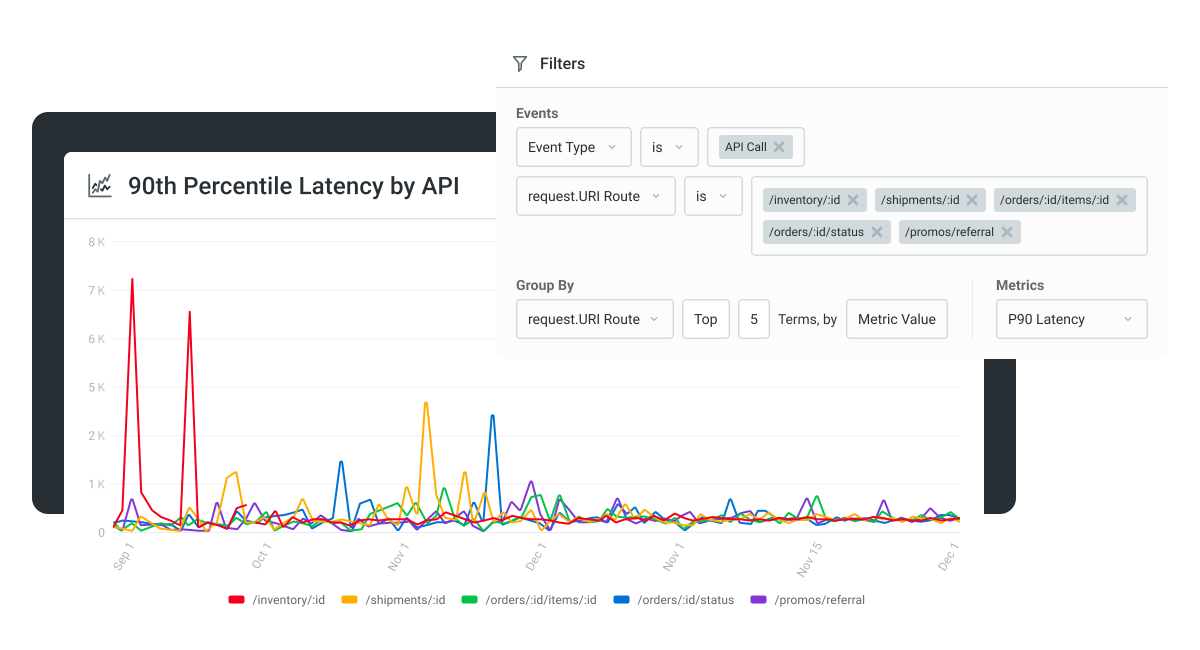
Moesif API monitoring sits behind the gateway and provides per-endpoint, per-customer, payload-level analytics across any gateway (WSO2, Kong, AWS API Gateway, Azure APIM, Envoy). The data feeds stage 7’s iterate decisions: which endpoints to deprecate, which customers to support more closely, which integrations are stalling.
Choosing your stack
The decision matrix for picking a stack in 2026:
| Use case | Recommended language + framework |
|---|---|
| New REST API for outside developers | Python / FastAPI or Node.js / Express |
| Internal microservice in a service mesh | Go / chi or Java / Spring Boot |
| Serving an ML model behind an HTTP endpoint | Python / FastAPI |
| API on top of an existing Django app | Python / Django REST Framework |
| High-throughput event ingestion | Go / Gin or Node.js / Fastify |
| Enterprise integration with SOAP backends | Java / Spring Boot |
Beyond the framework, three pieces span every stack: the gateway (handles auth, rate limiting, routing), the developer portal (handles docs, signup, key management), and the observability layer (handles per-customer analytics). The frameworks above pair with all of them.
If you are starting from scratch, our REST API tutorial walks through building an API end-to-end with Node.js and Express.
API development in 2026: AI agents, MCP, and AI-assisted spec generation
Three shifts changed how mature API teams develop in 2025-2026.
AI agents are first-class consumers. When an LLM application calls your API as part of a chain, the consumer is a model, not a human developer. That changes idempotency expectations (agents retry aggressively), versioning expectations (agents follow Deprecation headers when they exist), and observability needs (you have to attribute traffic to specific agents or workflows, not just customers).
MCP gave APIs a second interface. The Model Context Protocol exposes existing REST APIs in a shape agent runtimes can consume directly. The WSO2 AI Gateway auto-generates an MCP server from any OpenAPI spec, so the same API you publish for human developers becomes agent-consumable without a second build. The MCP and LLM proxy components sit inside the AI Gateway as the inbound and outbound paths respectively.
AI-assisted design is real. Tools generate OpenAPI specs from natural language now. Apigee ships Gemini Code Assist in Apigee for spec generation; WSO2’s API hub does similar work. The discipline shifted from “write the spec by hand” to “review the AI-generated spec carefully before locking it in.”
Common API development mistakes
The patterns we see most often in API platforms that are not working:
Designing the data model, not the contract. When the URL structure mirrors database tables, every schema change becomes a breaking API change. Design the API surface against the consumer’s mental model, not the storage layer.
Skipping the versioning policy. Picking URI versioning (/v1/orders) without writing down how long old versions stay live is how three-version APIs become eight-version APIs. State the deprecation period in the developer portal on day one.
No observability from day one. Adding analytics six months after launch means you cannot answer the basic question “which customer is hitting this endpoint?” Instrument from the first deployed call.
Sync APIs serving async work. If your endpoint kicks off a long-running job, return a 202 Accepted with a job ID and let the client poll, rather than holding an HTTP connection open for two minutes. Modern async patterns (job + status endpoint) handle this cleanly.
Treating MCP as a separate API. Building a separate REST API for human consumers and a separate API for agents doubles your maintenance work and guarantees they drift. Generate the MCP exposure from the same OpenAPI spec.
How Moesif and WSO2 cover the full API development lifecycle
Most API development stories stop at stage 3 or 4. The harder problems show up later: attributing usage to customers, exposing live consumption, deprecating cleanly, monetizing the API as a product.
The integrated WSO2 + Moesif stack covers all seven stages:
- Stages 1-2 (identify, design): WSO2 API Manager supports OpenAPI-first design with governance policies that run against the spec.
- Stages 3-4 (build, test): Your language and framework choice; WSO2 governance checks run against the spec at merge time.
- Stage 5 (govern, secure): WSO2 API Manager handles multi-gateway governance (WSO2, Kong, AWS, Azure, Envoy) with automated security policy enforcement.
- Stage 6 (deploy, publish): WSO2 generates the developer portal from the spec; the AI Gateway exposes the same API as an MCP server.
- Stage 7 (observe, iterate): Moesif provides per-endpoint, per-customer, payload-level analytics that feed iteration and deprecation decisions.
Alternative stacks exist: Postman covers stages 1-4 with a lighter platform layer (and lighter governance and analytics depth); Apigee, Kong, Azure APIM, and AWS API Gateway each cover stages 5-6 with different deployment and pricing models, and typically require additional tools for per-customer analytics and monetization. The right choice depends on which cloud your platform is on and how much of the lifecycle you want pre-built versus assembled.
Next steps
API development in 2026 is a seven-stage discipline. The platforms that span all seven stages are what enterprises buy; the teams that instrument from day one are the ones that get to stage 7 without surprises.
If you are shipping a new API and want per-endpoint, per-customer analytics in production within an hour of integrating, start a 14-day Moesif free trial. No credit card required.
Frequently asked questions
What is API development? API development is the process of designing, building, governing, deploying, and operating an API. It covers the technical work (spec, code, tests) and the platform work (governance, security, observability, monetization) that turn a working endpoint into a product customers integrate against.
How do I develop an API? Follow the seven stages above. Write an OpenAPI spec first, pick a framework that fits your team’s existing skills, test against the spec, govern security and rate limits at the gateway, deploy behind that gateway, publish to a developer portal, and instrument observability from day one.
What is the difference between API design and API development? Design is stage 2 of development. It produces the OpenAPI spec that the rest of development implements against. The full development lifecycle includes design plus six other stages.
What languages and frameworks are best for API development in 2026? Python (FastAPI for new APIs, Django REST Framework for existing Django apps, Flask for small services), Node.js (Express, Fastify), Go (chi, Gin), Java (Spring Boot). Pick the stack your team already knows.
Do I need an API platform? At a single API, no. At a dozen APIs and up, yes, because the alternative is each team inventing its own governance and observability, which leads to inconsistency and security gaps. WSO2, Apigee, Kong, MuleSoft, and IBM API Connect are the platforms enterprises typically evaluate.
How does AI change API development? AI agents are now first-class API consumers. That means idempotency keys on writes, careful Sunset and Deprecation headers, and observability that attributes traffic to specific agents. MCP exposes the same API to both humans and agents from a single spec.

Related Articles

API Strategy
Leveraging AI For a Better API Strategy
Learn how to leverage AI to build and fortify your API strategy. Improve design, governance, documentation, and align APIs with business outcomes.
API Strategy
The 5 Best Mixpanel Alternatives of 2025
Learn about the best Mixpanel alternatives to determine the right analytics solution for your use case.

API Development
How to Leverage Moesif Effectively for API Observability
Effectively leverage Moesif for API observability through best practices for integration, event enrichment, custom actions, and engineering workflow integrat...
API Strategy
How to Build an Internal Chargeback Model for Your API and AI Usage Using Moesif
Use Moesif to implement internal chargebacks and enable precise API and AI cost attribution for better transparency and resource optimization.