API Strategy in 2026: A Practical Framework

An API strategy is the plan that turns APIs from engineering output into a business asset. It covers which APIs you build, who they are for, how they are governed, how they are exposed and monetized, and how their performance ties back to business outcomes. Most organizations do not have an API strategy. They have an accumulation of APIs that grew organically, and the bill for that comes due about the time they reach a dozen services or their first paying API customer.

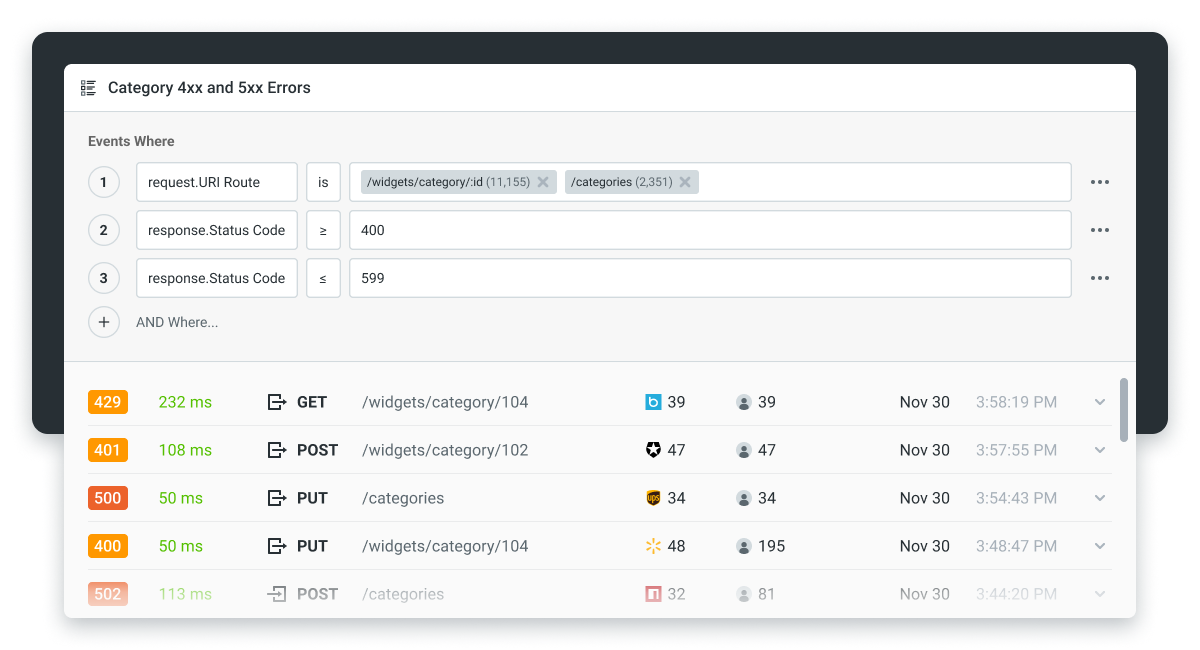
This guide walks through what a working API strategy actually contains in 2026, why the conversation now has to include AI agents and MCP, how to build a strategy from scratch, and the mistakes that quietly kill API programs.
What is an API strategy?
An API strategy is the documented set of decisions and policies that govern how an organization designs, builds, exposes, and operates its APIs. It sits above individual API design and below corporate technology strategy. The strategy answers: which APIs exist and why, who consumes them, how they evolve over time, how their performance maps to business goals, and which platform decisions support all of that.
An API strategy is not a roadmap of which APIs to ship next quarter. That is a tactical plan. The strategy is the framework that produces those plans.
Why API strategy is becoming AI strategy in 2026
The dominant conversation in 2025-2026 is that the boundary between API strategy and AI strategy has effectively dissolved. Industry surveys and analyst commentary on API platform adoption increasingly treat them as the same problem, and we see the same pattern across enterprise customers.
Three shifts drove it:
- AI agents are first-class API consumers. When an LLM application calls your API as part of a chain, the consumer is a model, not a human developer. Your API strategy now has to account for agent traffic patterns, retry behavior, and per-agent attribution.
- MCP gives APIs a second runtime. The Model Context Protocol exposes existing REST APIs to agent runtimes through a different surface. Your strategy has to decide whether you maintain the API once and expose it through MCP generated from the same OpenAPI spec, or treat MCP as a separate workstream.
- AI cost and governance are API problems. Outbound LLM calls (your application calling OpenAI, Anthropic, etc.) are API consumption from your side. Tracking, governing, and budgeting that consumption uses the same tools and patterns as the APIs you expose to others.
The teams that treat AI strategy as a separate workstream from API strategy end up doing the same governance work twice.
The 6 components of a working API strategy
A complete API strategy has six components.
1. Audience and value. Who consumes your APIs, what they need, and what outcome the API enables. External developers integrating commercially, internal teams reducing engineering coordination, AI agents accessing enterprise data, partners under contract. Each audience has different design and governance implications.
2. API portfolio model. How APIs are grouped, named, versioned, and discovered. Some organizations run a single API surface; others run dozens. The strategy decides which APIs are public, which are partner-only, which are internal, and how new APIs get proposed.
3. Governance and security baseline. The non-negotiables every API must meet: design conventions, authentication, rate limiting, logging, sunset policy. The strategy defines them once; individual API teams inherit them.
4. Platform decisions. Which API gateway, developer portal, observability layer, and monetization layer the organization uses. Whether you assemble multiple best-of-breed tools (Postman + Kong + Datadog + Stripe) or run on a single platform (WSO2, Apigee, MuleSoft, IBM API Connect). The trade-off is integration cost versus the flexibility to customize.
5. Measurement. How API success ties back to business outcomes. Integrations shipped per quarter, agent calls per month, revenue from consumption, time-to-first-call, support cost per API.
6. Lifecycle discipline. How APIs move from design to retirement deliberately. The API lifecycle is the operational expression of strategy.
A strategy that misses any of these six components will produce APIs that work in isolation but do not compound into a platform.
Security and monetization as strategy decisions
Two of the six components (governance/security baseline and platform decisions) generate more debate in practice than the other four combined. They are also the two that most directly affect external users, so the strategy decisions show up in customer-facing outcomes.
Security as a strategy decision, not a checklist. Most strategy documents treat security as a one-page checklist: “use OAuth, enforce rate limits, validate inputs.” That is the floor, not the strategy. The actual strategic questions are harder. Which authentication patterns do you support across the portfolio? OAuth 2.0, mTLS, API keys for read-only public endpoints, signed requests for partner traffic each fit different audiences. Where does authorization live: in the gateway, in each service, or in a separate policy engine? How do you handle credential rotation and revocation at scale? And critically in 2026, how do you authenticate agent traffic distinctly from human-developer traffic, so that you can apply different rate limits, audit trails, and per-agent attribution? Treating these as five separate decisions made by five different teams is how enterprise API portfolios end up with seven authentication patterns nobody can fully document.
Monetization as a strategy lever. Even if your APIs are not directly billed, monetization decisions shape strategy. Free public APIs need different rate-limiting and abuse-prevention than paid commercial APIs. APIs offered to partners on contract need SLA tracking and per-customer reporting that internal-only APIs do not. APIs that consume third-party services (your application calling OpenAI, Stripe, Twilio) need cost attribution back to the customer driving the call. The strategy says: which APIs are revenue-generating, which are cost-recovery, which are commodity/free, and what infrastructure investments each category justifies. Our API pricing strategy guide covers the pricing-model trade-offs (per-call, per-token, tiered, usage-bundle) in more depth, but the strategic question is which APIs warrant the analytical and billing investment at all.
The platforms that integrate security policy enforcement, per-customer monetization, and AI/agent traffic governance into one runtime (WSO2 plus Moesif on the analytics-and-billing side) exist because doing this with five separate vendors becomes its own coordination tax. The trade-off is integration cost versus the flexibility to swap pieces.
Developer engagement: the portal-as-product idea
The most-overlooked component of an API strategy is how external (and increasingly, internal) developers actually adopt the APIs. Engineering teams tend to think the API itself is the product. In practice, the developer’s path from “I heard about this API” to “I have a working integration in production” passes through documentation, code samples, SDKs, a developer portal, and support; and any one of those being broken kills adoption regardless of how well-designed the API is.
A working strategy treats the developer experience as a product owned by a product manager, not as documentation owned by no one.
The components most strategies underinvest in:
- A first-class developer portal with searchable docs, interactive try-it consoles, SDK downloads, and self-service auth. The portal is where new developers form their first impression of your platform.
- SDKs in the languages your audience actually uses. A REST API with no SDKs forces every consumer to write HTTP-call boilerplate. SDKs in 3-5 dominant languages (TypeScript, Python, Go, Java, Ruby) compress integration time meaningfully.
- Sample applications, not just reference docs. A working sample app that demonstrates the common integration patterns is worth more than another 50 pages of endpoint documentation.
- A dedicated developer-support channel. Slack/Discord community, ticketed support, or a public forum where developers can get unblocked. Teams that route API support through general customer-support tickets bury the technical questions and frustrate developers.
- Time-to-first-call as a tracked metric. How long does it take a brand-new developer to go from signup to their first successful API call? Stripe famously optimizes for this; few enterprises measure it.
The strategy decision is how much of this you build in-house versus buying. Developer-portal generators (some bundled with API management platforms, some standalone) take you from zero to functional quickly. SDK generation tools (OpenAPI Generator, Stainless, Speakeasy) cut the SDK maintenance burden meaningfully. The integrated platforms (WSO2, Apigee, MuleSoft) generate the portal from the OpenAPI spec, which keeps it in sync without manual updates.
API strategy in enterprise digital transformation
Digital transformation is a broader corporate initiative that almost always depends on APIs as the integration layer, but it is rarely run by the same team that owns the API strategy. The disconnect between those two groups is where transformation programs slow down, and where API strategy can either accelerate or block the broader effort.
The pattern: a digital transformation initiative announces it will modernize legacy systems by exposing them through APIs. The legacy team builds APIs that reflect the legacy data model. The downstream consumers (internal apps, partner integrations, agent runtimes) find these APIs hard to use because they leak implementation detail. The transformation slows down. The API strategy team gets called in to clean up after the fact.
The cleaner pattern: the API strategy owns the consumer-facing contract from day one, and the legacy modernization is the implementation detail. The strategy specifies what the consumer-facing API should look like; the legacy team builds whatever adapter is needed to expose the legacy system through that contract.
The strategic questions:
- Which APIs are the digital transformation deliverables? Not every modernized system needs an external API; some are internal-only. Define this upfront.
- Who owns the contract? Platform engineering owning the contract specification keeps it consumer-facing. Legacy teams owning it produces leaky abstractions.
- What is the deprecation path for the legacy interface? Some transformations expose APIs on top of the old system as a permanent compatibility shim; others use the API as a stepping stone to a full replacement. The strategy should be explicit about which.
- How does the AI surface fit? Increasingly, digital transformation programs include “make this data accessible to AI agents” as a deliverable. If your API strategy already has an AI/MCP layer, the transformation reuses it. If not, the program creates a parallel AI workstream that duplicates governance and security policy.
Most enterprise transformation programs we see start treating API strategy as a separate, optional input and end up either restarting the API contract work or shipping APIs that the API strategy team has to redesign.
API-first strategy vs. service-first strategy
Two opposing philosophies show up repeatedly when organizations design their API approach.
API-first means designing the API contract before building the service. The OpenAPI spec is the source of truth; the implementation follows. Stripe and Twilio are the textbook examples. Pros: clean consumer experience, parallel client/server development, easier governance enforcement at the spec level. Cons: more upfront design work; less freedom for the implementation team.
Service-first means building the service to meet internal needs, then exposing an API on top. Most enterprises grew this way. Pros: faster initial delivery; fits when the business case is internal rather than external. Cons: APIs reflect the implementation rather than the consumer; harder to govern consistently.
The 2026 default for new APIs is API-first. Service-first remains common in legacy modernization projects, but rarely chosen on new builds.
How to build an API strategy from scratch
A practical sequence for organizations starting from no formal strategy:
- Inventory what exists. List every API the organization currently runs, who owns it, who consumes it, and what it does. Most teams substantially underestimate this on the first pass, because shadow APIs (services exposed by individual teams without going through the platform group) rarely show up in central documentation, and tracing them down often surfaces several times as many endpoints as the platform team thought they had.
- Define the audiences. Who are your API consumers? Be specific. “External developers” is not specific; “fintech platform teams integrating our payments API” is. Each audience surfaces different priorities: external developers care about docs and SDKs, partners care about SLAs, AI agents care about idempotency and clear endpoint descriptions.
- Pick the success metrics. Two to four metrics, no more. They should map directly to business outcomes: revenue from API consumption, integrations shipped per quarter, time-to-first-call for new developers, agent calls per month. Vanity metrics (total requests, total endpoints) tell you nothing about strategy effectiveness.
- Draft the governance baseline. The non-negotiables every API must meet. Keep it short on the first pass: auth standards, naming conventions, error format, rate limiting defaults, deprecation policy. You can add as you learn what teams keep doing wrong.
- Choose the platform stack. Gateway, developer portal, observability, monetization. Document the choices and the reasons. Re-evaluate annually, because the tool landscape changes quickly and an honest 12-month look often surfaces gaps.
- Publish the strategy internally. A short document (10-15 pages, not 50). Make it findable by every team that ships APIs, and add it to the platform engineering onboarding so new hires read it in week one.
- Audit quarterly. Compare what the strategy says with what teams are actually doing. Update the strategy when reality has moved. A strategy that is never revised becomes folklore that nobody follows.
The biggest pitfall is making the strategy too detailed to maintain. A 50-page strategy document goes stale within a year and is never updated. A 10-page strategy that gets revised every quarter survives.
For the monetization slice specifically, our API pricing strategy guide covers the unit-of-value and pricing-model decisions in depth.
Common API strategy mistakes
The patterns we see across enterprise customers.
Treating API strategy as an engineering exercise. APIs are products. Strategy needs product, platform, and business inputs, not just architecture decisions. The strategies that fail are the ones written entirely by the platform engineering team.
Skipping the audience definition. Without a clear audience, governance defaults to the lowest common denominator (which protects nothing) or the highest (which over-engineers everything). Pick the audiences first.
Choosing the platform before the strategy. Selecting Apigee or Kong or WSO2 before the strategy says what the platform needs to support is how enterprises end up with expensive tools that do not match their actual workflow. The strategy defines requirements; the platform is the answer.
Confusing AI strategy with API strategy. They are now the same conversation. Running them separately produces duplicate governance work and contradicting policies.
No retirement plan. Most strategies focus on building. The ones that stay coherent over time also have a discipline for retiring APIs: deprecation policy, sunset header usage, sunset date tracking. Without it, three-version platforms become eight-version platforms.
Strategy without measurement infrastructure. A strategy that names success metrics but does not invest in the observability to measure them produces quarterly slides full of guesses. If “revenue from API consumption” is a metric, you need per-customer call data tied to billing. If “agent calls per month” is a metric, you need attribution that separates agent traffic from human-developer traffic. Pick metrics you can actually measure, or invest in the tooling to measure the ones you picked.
How Moesif and WSO2 fit into an enterprise API strategy
Most strategy documents stop at “pick a platform.” The harder question is which tools cover which parts of the strategy without requiring your platform team to integrate five vendors.
The integrated WSO2 + Moesif stack covers:
- Governance and security baseline (WSO2 API Manager) with policies enforced against the OpenAPI spec at merge time
- Multi-gateway runtime (WSO2 API Manager) across WSO2, Kong, AWS, Azure, Envoy
- AI surface (WSO2 AI Gateway) for inbound MCP traffic and outbound LLM calls
- Developer portal generated from the spec
- Observability (Moesif) with per-endpoint, per-customer, payload-level analytics
- Monetization (Moesif Billing Meters) with sync to Stripe, Recurly, Chargebee, Salesforce
The alternatives are real: Postman covers design with a lighter platform layer (and lighter governance and analytics depth); Apigee, Kong, MuleSoft, and IBM API Connect each cover the gateway-plus-governance layer with different cloud-fit, pricing, and lock-in trade-offs. The choice depends on which cloud your platform runs on, how much of the lifecycle you want pre-built rather than assembled yourself, and whether AI traffic is a meaningful share of your usage.
Next steps
API strategy is a living document, not a one-time deliverable. Pick the audiences, define the governance baseline, choose the platform, set the metrics, and revise quarterly.
If you are ready to see what your APIs are actually doing in production against the strategy you set, start a 14-day Moesif free trial for per-endpoint, per-customer analytics in production. No credit card required.
Frequently asked questions
What is an API strategy? A documented set of decisions about which APIs an organization builds, who consumes them, how they are governed, and how their performance ties to business outcomes. It sits above tactical roadmaps and below overall technology strategy.
What is API-first strategy? Designing the API contract before building the implementation. The OpenAPI spec becomes the source of truth and the implementation follows. The opposite is service-first, where the service is built first and an API is layered on top.
Why is API strategy important in 2026? Because the boundary between API strategy and AI strategy dissolved. Agent consumption, MCP exposure, and outbound LLM governance all use the same tools and patterns as the APIs you expose to others. Treating them separately produces duplicate work.
How long should an API strategy document be? Ten to fifteen pages. Anything longer goes stale and stops getting updated. A short, frequently-revised strategy beats a comprehensive one that has not been touched in a year.
Who owns the API strategy? A cross-functional working group: platform engineering, product, security, and (increasingly) the AI platform team. Single-owner strategies fail because they miss inputs from one of those four perspectives.
How does API strategy connect to API governance? Governance is the enforcement layer of the strategy. The strategy says what the rules are; governance makes sure individual API teams follow them. Without strategy, governance is arbitrary; without governance, strategy is theoretical.
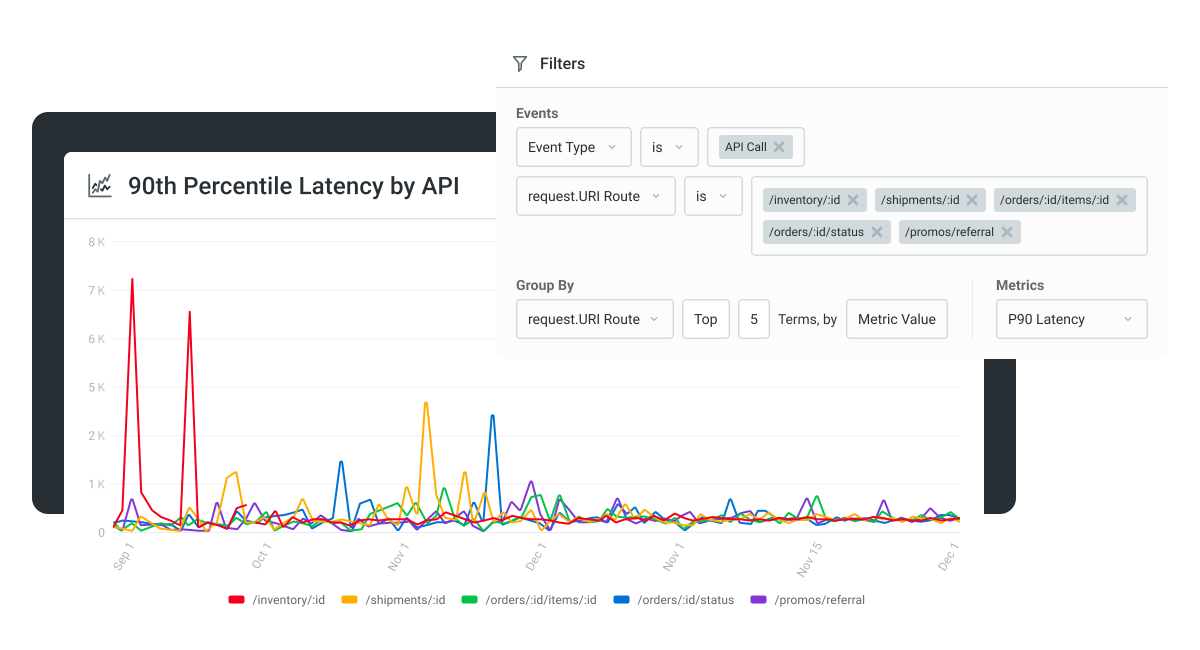

Related Articles

API Strategy
Leveraging AI For a Better API Strategy
Learn how to leverage AI to build and fortify your API strategy. Improve design, governance, documentation, and align APIs with business outcomes.
API Strategy
The 5 Best Mixpanel Alternatives of 2025
Learn about the best Mixpanel alternatives to determine the right analytics solution for your use case.

API Development
How to Leverage Moesif Effectively for API Observability
Effectively leverage Moesif for API observability through best practices for integration, event enrichment, custom actions, and engineering workflow integrat...
API Strategy
How to Build an Internal Chargeback Model for Your API and AI Usage Using Moesif
Use Moesif to implement internal chargebacks and enable precise API and AI cost attribution for better transparency and resource optimization.