API Lifecycle: The 7 Stages from Design to Retirement
The API lifecycle is the set of stages an API goes through, from the moment a designer sketches an endpoint on a whiteboard to the day that endpoint is finally retired and a 410 Gone response replaces it. Most articles describe five or six stages. We describe seven, because the last stage (the deliberate retirement of an API version) is the one teams skip most often and pay for most painfully.

This post walks through each stage, what actually happens inside it, and the tools that span them. By the end you will have a working framework for thinking about where your API is in its life and what needs to happen next.
What is the API lifecycle?
The API lifecycle is the structured set of stages an API passes through from initial design to eventual retirement. Each stage has its own activities, decisions, and risks. Treating the lifecycle as a single repeating cycle (instead of a one-shot project) is how mature API teams keep multiple versions running without breaking customers.
For organizations that operate dozens or hundreds of APIs, lifecycle management is one of the core jobs of an API platform. Postman, Akamai, IBM, MuleSoft, and WSO2 all sell tools around it. The seven stages below are vendor-agnostic; the platform you pick determines how integrated those stages feel in practice.
The seven stages of the API lifecycle
| # | Stage | Primary owner | Output |
|---|---|---|---|
| 1 | Plan and design | Product + Architecture | OpenAPI spec, requirements doc |
| 2 | Build | Engineering | Working API server |
| 3 | Test | QA + Engineering | Passing test suite, contract tests |
| 4 | Govern and secure | Platform team | Approved spec, security review sign-off |
| 5 | Deploy and publish | Platform + DevOps | Live endpoint, developer portal listing |
| 6 | Observe and analyze | Platform + Product | Usage dashboards, alerts, customer insight |
| 7 | Iterate, deprecate, retire | Product + Engineering | New version, deprecation calendar, retired endpoints |
The stages overlap in practice. A v2 endpoint can be in build at the same time as a v1 endpoint is in observe-and-analyze. The framework helps a team know what they are responsible for at each moment.
Stage 1: Plan and design
The lifecycle starts before any code. The plan stage answers three questions:
- Who is the consumer? External developers integrating commercially, internal teams, AI agents, or some combination?
- What problem does this API solve? The mistake most new APIs make is exposing a database when they should expose a workflow.
- What does success look like? A measurable target: integrations shipped per quarter, agent calls per month, revenue from API consumption, ticket reduction.
The design stage turns the plan into an artifact. In 2026 that artifact is almost always an OpenAPI specification, written first, before any server code. An OpenAPI-first workflow gives you a single source of truth that generates server stubs, client SDKs, and documentation by construction. Our API design principles guide covers the design decisions that compound across the rest of the lifecycle.
Stage 2: Build
The build stage implements the OpenAPI spec. The work splits into three layers:
- Routing and request handling: turning HTTP requests into function calls in your language of choice.
- Business logic: the actual work the API does. Talking to databases, calling other services, computing the answer.
- Response shaping: serializing results into the response shape your spec promises.
The framework you pick (Express in Node, FastAPI in Python, Spring in Java, etc.) handles the first and third layers; the second is yours. The discipline that matters at this stage is not letting the implementation drift from the spec. Generate stubs from the spec; do not hand-write routes.
Stage 3: Test
Testing an API runs across three levels:
- Unit tests for individual functions and route handlers.
- Integration tests that hit the API end-to-end with realistic payloads.
- Contract tests that verify the API’s actual behavior matches the OpenAPI spec. Tools like Dredd or Schemathesis read your spec and generate requests that exercise every endpoint.
Status codes are where most contract violations show up. If your spec says POST /orders returns 201 Created and your implementation returns 200 OK, every consumer that branches on status code is in trouble. Our HTTP status codes reference covers the right code for every common scenario.
Idempotency testing is the underrated discipline in 2026. AI agents retry requests. If your POST endpoints are not safe to retry, agent traffic will create duplicate resources in production. Test with explicit Idempotency-Key headers and verify retries return the same response.
Stage 4: Govern and secure
Governance is the stage that separates a hobby API from a production one. The platform team enforces:
- Naming conventions: plural nouns for collections, predictable nesting, no
/createUserendpoints. - Security minimums: TLS 1.2 or higher, OAuth or mTLS authentication, no PII in URLs.
- Schema compliance: every endpoint must be documented in the OpenAPI spec; specs must pass policy checks.
- Rate limiting and quotas: every public endpoint has a default rate limit, with overrides for enterprise customers.
- Audit logging: every call attributable to a customer, retained long enough to support investigations.
This is where API platforms earn their keep at scale. Manual review on every spec change does not survive past about a dozen APIs. Automated governance against the OpenAPI spec at merge time does.
Stage 5: Deploy and publish
Two distinct activities happen in this stage.
Deploy is moving the code to a runtime environment. Modern paths in 2026 are managed platforms (Vercel, Railway, Render, Fly), container runtimes (AWS ECS, Google Cloud Run, Azure Container Apps), or Kubernetes if your team operates a cluster. The API gateway sits in front, handling auth, rate limiting, and routing.
Publish is making the API discoverable to its consumers. For an external open API, that means a developer portal: docs generated from the OpenAPI spec, a self-service signup flow for API keys, code examples, an interactive explorer, and a changelog. For an internal API, the equivalent is an internal developer portal entry.
A common mistake here is treating publish as an afterthought. The developer portal is the surface where adoption happens. Time-to-first-call (the minutes between signup and a successful API call) is the single best leading indicator of integration success.
Stage 6: Observe and analyze
Once the API is live, the question shifts. It is no longer “does it work?” but “does it work for the right customers, at the right latency, with the right error rates?”
The observability discipline at this stage answers three questions:
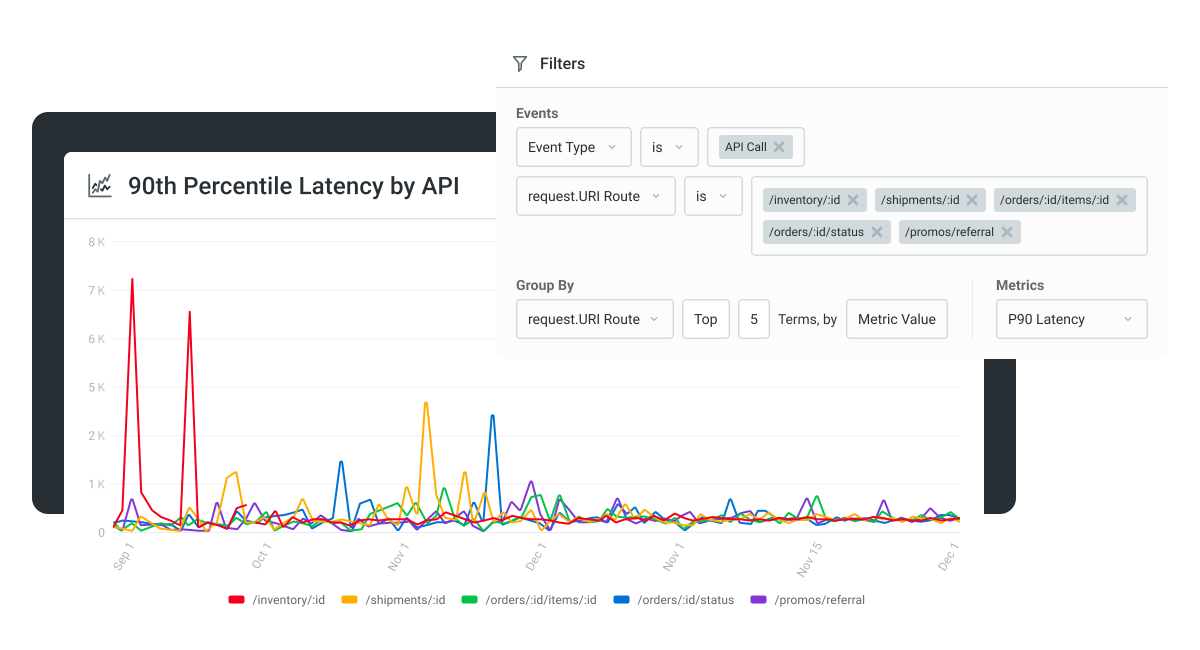
- Is it fast? P50 and P95 latency, broken down per endpoint, per region, per customer.
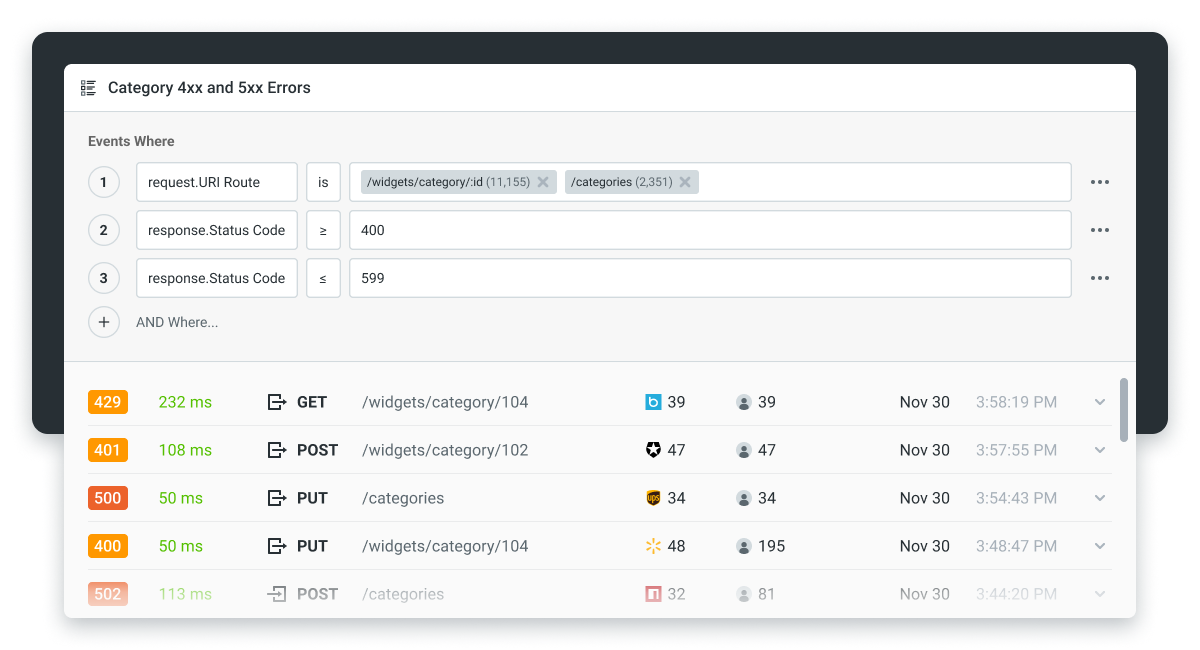
- Is it correct? Error rate distribution, by status code, by customer, by endpoint.
- Who is calling it? Usage by customer cohort, endpoint adoption curves, agent vs. human traffic split.
These three questions are why API observability exists as a discipline separate from infrastructure monitoring. Server-level metrics tell you CPU and memory; they do not tell you that customer X is getting 500s on /v1/orders while everyone else is fine.
Moesif API monitoring covers the API-specific layer: per-endpoint, per-customer, payload-level visibility across any gateway, with usage events that flow into billing and product dashboards. The integration from gateway to observability layer is what closes the loop between the API as a piece of infrastructure and the API as a product.
Stage 7: Iterate, deprecate, retire
This is the stage teams underinvest in.
Iterate is the easy part. Usage data from stage 6 feeds back into stage 1, and the cycle continues for new endpoints and new versions. The new versions ship.
Deprecate is harder. When an old version is replaced, customers who built on it need warning. The standard discipline: announce the deprecation publicly, set a sunset date (twelve months for paid public APIs, six months for free public APIs, ninety days for internal APIs), send reminders, and use the Sunset and Deprecation HTTP response headers so SDKs can warn developers automatically.
Retire is the part that does not feel productive but is the part that defines a mature platform. Old versions cost money to run, fragment your support load, and slow every future change. When a deprecation period ends, the old version actually has to go offline. Many teams keep “deprecated” versions running for years out of risk aversion, which is how three-version platforms become eight-version platforms and engineering velocity collapses.
The retirement decision should be made on data: how many customers, how much revenue, how often called. Stage 6’s analytics are exactly the inputs to stage 7’s retirement decision.
Who owns the API lifecycle: team patterns that work
The seven-stage lifecycle assumes someone is accountable for it. In small organizations that is one engineer wearing multiple hats. In large organizations the lifecycle spans product, platform engineering, security, and developer-experience teams, and the failure mode is that no single owner has end-to-end visibility.
The patterns that work in practice:
Dedicated platform team owns the lifecycle framework. A small platform engineering or developer-experience team (3-10 people in most enterprises) owns the lifecycle definition itself: which tools each stage uses, what the governance rules are, how new APIs get proposed. They do not build every API; they build the paved road that other teams use to build APIs.
Per-API product owners drive individual lifecycles. Each API has a product owner (or technical product manager) who is accountable for its position in the lifecycle. They decide when an API moves from design to build, when it ships to production, when it is deprecated. The platform team provides the runway; the product owner steers the plane.
Engineering teams build, but to the framework. Engineering teams ship the API itself, following the design rules, security baseline, and observability requirements the platform team published. The discipline is that engineering does not invent new patterns per-API; they apply the framework the platform team maintains.
Security and compliance teams provide gates, not bottlenecks. Security review at design time (spec linting, threat modeling for high-risk APIs) is faster and cheaper than security review at production time. The mature pattern is automated security checks integrated into CI/CD with periodic deep-review for high-risk cases, not manual review of every API.
Developer-experience and documentation are a function, not a side job. Maintaining the developer portal, writing SDKs, running developer support, and tracking time-to-first-call as a metric is a full-time function in any organization that runs a meaningful API platform. Teams that assign developer-experience as a 20% project to engineers consistently underinvest in it.
Cross-functional working group reviews the portfolio. A monthly or quarterly forum where product, platform engineering, security, and (increasingly) the AI platform team review the full API portfolio together. Decisions made here are deprecation timelines, new API proposals, and lifecycle exceptions. Without this forum, APIs accumulate in the portfolio with no one explicitly authorized to retire them.
Put differently: lifecycle ownership is rarely a single role; it is a coordination function across roles that the platform team facilitates. The platform team’s success metric is not “how many APIs we built” but “how easily other teams can move APIs through the lifecycle.”
API lifecycle in 2026: agents, MCP, and the AI surface
The lifecycle framework above is mostly unchanged from five years ago, but two things did change.
AI agents are a first-class consumer. When an MCP server fronts your API, the consumer of stages 1-7 is now an agent, not just a human developer. Two implications: design (stage 1) needs to think about agent-friendly operation IDs and descriptions in the OpenAPI spec, and observability (stage 6) needs to attribute traffic to specific agents and workflows, not just customers.
The AI surface needs its own governance. Outbound LLM calls (your application calling OpenAI, Anthropic, etc.) have a lifecycle too: prompt design, token budgeting, model selection, evaluation, and retirement of old prompts. The WSO2 AI Gateway treats outbound LLM traffic and inbound MCP traffic under the same governance model as REST APIs, which is the simplest way to extend lifecycle thinking to AI workloads.
How the WSO2 API Platform and Moesif cover the full lifecycle
Most lifecycle articles stop at the framework. The harder question is which tools span which stages without making your platform team integrate five vendors.
The integrated WSO2 + Moesif stack covers:
- Stage 1 (design): WSO2 API Manager supports OpenAPI-first design with policy enforcement at the spec level.
- Stages 2 + 3 (build, test): Your language and framework choice; WSO2 publishes governance checks that run against the spec.
- Stage 4 (govern, secure): WSO2 API Manager handles multi-gateway governance (WSO2, Kong, AWS, Azure, Envoy) and applies security policies automatically.
- Stage 5 (deploy, publish): WSO2 generates the developer portal from the spec; the AI Gateway exposes the same API as an MCP server for agent consumption.
- Stage 6 (observe, analyze): Moesif sits behind the gateway and provides per-endpoint, per-customer, payload-level analytics.
- Stage 7 (iterate, retire): Moesif analytics feed the retirement decision; WSO2 publishes deprecation policies and enforces sunset headers.
The tools you can swap in for individual stages: Postman or Stoplight cover design with lighter governance and analytics; Apigee, Kong, or Tyk cover the gateway with different lifecycle depth; Datadog or New Relic cover some operational-monitoring questions but not the per-customer business analytics. The platform decision is whether you want one stack that spans the full lifecycle (WSO2 + Moesif) or to integrate multiple best-of-breed tools yourself and accept the integration cost.
Next steps
The lifecycle framework is most useful when you know which stage your API is in and what needs to happen next. If you are in stage 6 and your observability tooling is the bottleneck, start a 14-day Moesif free trial and get per-endpoint, per-customer analytics in production within an hour of integrating. No credit card required.
Frequently asked questions
What are the stages of the API lifecycle? Plan and design, build, test, govern and secure, deploy and publish, observe and analyze, and iterate-deprecate-retire. Most frameworks call it five or six stages by combining the planning and design steps, or by dropping retirement.
What is API lifecycle management? API lifecycle management is the practice of running and governing APIs across all stages above, usually with a platform that integrates the tooling. Postman, IBM API Connect, MuleSoft, Apigee, Kong, and the WSO2 API Platform are common choices.
Who manages the API lifecycle? Typically the platform team or API platform organization. For smaller companies, it may be the same engineering team that builds the API. For enterprises, design and governance are platform team responsibilities, build is the API team, and operations sit with both.
What is the difference between API lifecycle and API management? The lifecycle is the conceptual framework; API management is the tooling and platform that implements it. You can do lifecycle management with spreadsheets and discipline; an API management platform automates governance, deployment, and observability across many APIs.
How long should an API stay deprecated before retirement? Twelve months is the standard for paid public APIs, six months for free public APIs, and ninety days for internal APIs. Publish a sunset date on day one of the deprecation, use the Sunset and Deprecation HTTP headers, and stick to the date.

Related Articles

API Strategy
Leveraging AI For a Better API Strategy
Learn how to leverage AI to build and fortify your API strategy. Improve design, governance, documentation, and align APIs with business outcomes.
API Strategy
The 5 Best Mixpanel Alternatives of 2025
Learn about the best Mixpanel alternatives to determine the right analytics solution for your use case.

API Development
How to Leverage Moesif Effectively for API Observability
Effectively leverage Moesif for API observability through best practices for integration, event enrichment, custom actions, and engineering workflow integrat...
API Strategy
How to Build an Internal Chargeback Model for Your API and AI Usage Using Moesif
Use Moesif to implement internal chargebacks and enable precise API and AI cost attribution for better transparency and resource optimization.