Python API Resources: Frameworks, Tutorials, Tools (2026)
Python is one of the most common languages for building REST APIs in 2026, and the ecosystem has consolidated meaningfully over the last few years. This guide curates the resources worth bookmarking if you are building or maintaining a Python API: framework tutorials, deployment paths, libraries, and the observability layer that closes the loop.

For a deeper framework comparison, see our Python REST API frameworks guide. For a step-by-step build with FastAPI, see our FastAPI tutorial. This post is the curated index that links out to the broader ecosystem.
Why Python for APIs in 2026
Python’s relevance for APIs grew, not shrank, over the last few years. Three reasons keep it on most teams’ shortlist:
- Async support stabilized. FastAPI is async-native, Flask added async view support in 2.0, and Django 5.x has substantially expanded async ORM support. The “Python is slow” objection rarely holds for I/O-bound API work.
- Type hints became table stakes. FastAPI uses Python type hints to validate requests and generate OpenAPI specs automatically. Pydantic catches a class of bugs that used to live in production.
- ML and AI serving made Python the default language. A meaningful share of new APIs in 2026 wrap an LLM call or a model inference; Python is where those models live, so the API and the model end up in the same process.
REST API framework tutorials
The three frameworks worth knowing in 2026:
- FastAPI. The default for new APIs. Async-native, type-hint-driven validation, auto-generated OpenAPI docs. Official tutorial at
fastapi.tiangolo.com/tutorial. The framework’s 2026 add-ons include thefastapi[standard]install (which bundles the FastAPI CLI forfastapi dev) and FastAPI Cloud (private beta with public waitlist) for one-command managed deployment. - Django REST Framework. The default when you are already on Django. Deep integration with Django models, browsable API for development, mature ecosystem. Official tutorial at
django-rest-framework.org/tutorial. - Flask. Still strong for small APIs and prototypes. Pair with Flask-Smorest or Flask-RESTful for API-specific features. Official quickstart at
flask.palletsprojects.com.
Frameworks that were on this list a few years ago but no longer are: Bottle (community shrunk significantly), Pyramid (still maintained but rarely chosen for new projects), Web2py (effectively legacy).
GraphQL API tutorials
For GraphQL on Python, three libraries are worth knowing:
- Strawberry. Type-hint-driven, code-first GraphQL. The 2026 default for new Python GraphQL APIs. Documentation at
strawberry.rocks. - Graphene. Older library, still maintained, common at companies that adopted GraphQL early. Documentation at
graphene-python.org. - Ariadne. Schema-first GraphQL with a clean async story. Documentation at
ariadnegraphql.org.
Strawberry is the safe default for new projects; the other two are reasonable choices for existing codebases.
Async patterns and tutorials
For pure async or WebSocket-heavy APIs:
- aiohttp. Server and client toolkit for async HTTP. Useful when you need explicit control over the event loop.
- Starlette. The ASGI toolkit FastAPI is built on. Use directly when you want async routing without FastAPI’s Pydantic conventions.
- Litestar. A newer ASGI framework (formerly Starlite) emphasizing type safety and performance. Worth evaluating for teams that want FastAPI’s ideas with different design trade-offs.
These three are alternatives to FastAPI for specific use cases; FastAPI itself remains the broadest default.
Deployment guides
The 2026 deployment landscape for Python APIs:
- Fly.io, Render, Railway. Managed platforms with strong Python defaults. Push code, get a URL. Lowest-friction for small-to-medium APIs.
- AWS. Multiple paths: AWS Lambda (with Mangum or AWS Lambda Powertools for FastAPI integration), AWS App Runner (container-based, lower complexity than Fargate), AWS Elastic Beanstalk (legacy but still works).
- Google Cloud. Cloud Run is the standard Python deployment path; serverless containers with autoscaling.
- Azure. Azure Container Apps or Azure App Service. The latter is more managed; the former gives more control.
- Kubernetes. For teams already operating a cluster. The standard Python container pattern (Dockerfile with
uvicornorgunicorn) deploys cleanly. - FastAPI Cloud. Managed FastAPI deployment from the FastAPI team (fastapicloud.com); private beta with a public waitlist at the time of writing. Deploys via a single
fastapi deploycommand.
The choice depends mostly on existing infrastructure. Greenfield API projects in 2026 typically start on a managed platform (Render, Railway, Fly) and migrate to containers or Kubernetes once scale requires it.
Essential libraries
The libraries worth knowing for any production Python API:
- Pydantic. Data validation and settings management. The foundation FastAPI builds on; useful in any Python codebase.
- httpx. HTTP client with sync and async APIs. The 2026 replacement for
requestswhen you need async or HTTP/2. - SQLAlchemy. The standard ORM for Python. SQLAlchemy 2.0+ has full async support.
- Tortoise ORM / SQLModel. Async-native ORM alternatives. SQLModel (from FastAPI’s creator) integrates Pydantic and SQLAlchemy.
- python-jose / pyjwt. JWT handling for authentication.
- passlib. Password hashing.
- Authlib. OAuth and OIDC client/server library.
- httpx-cache or fastapi-cache. Response caching middleware.
- slowapi. Rate limiting middleware for FastAPI.
- structlog. Structured logging.
- OpenTelemetry-Python. Distributed tracing.
Most production Python API codebases use 8-12 of these. Picking them deliberately on day one is cheaper than retrofitting later.
Observability and monitoring
The libraries above instrument the application. The observability layer instruments the API as a product.
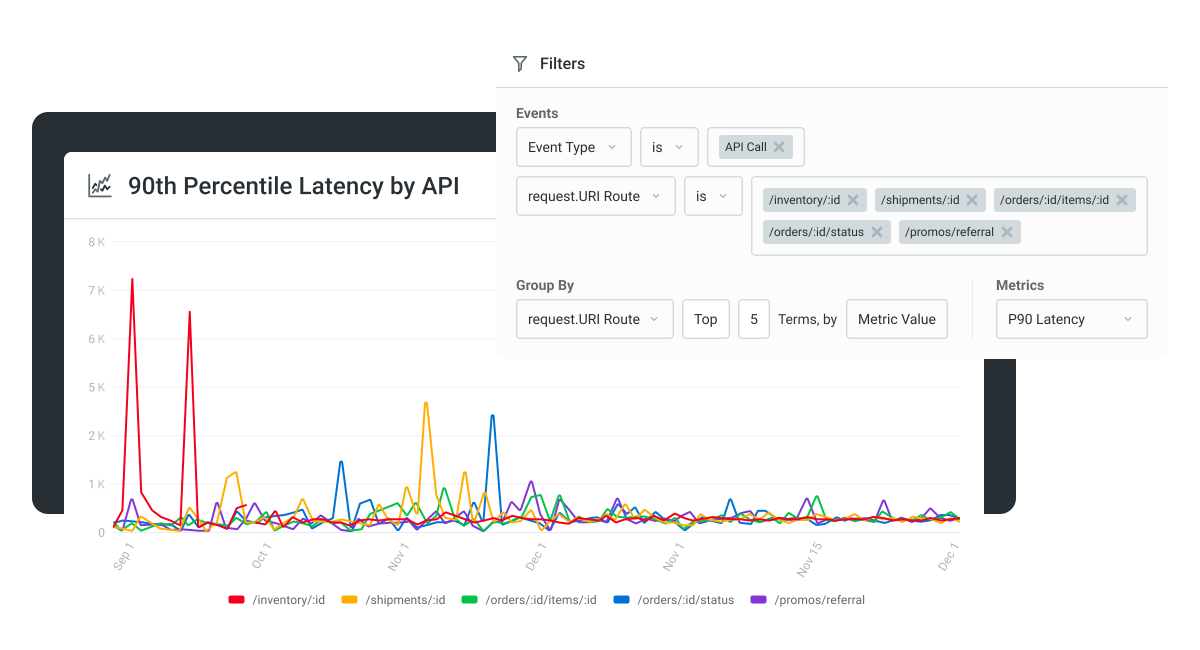
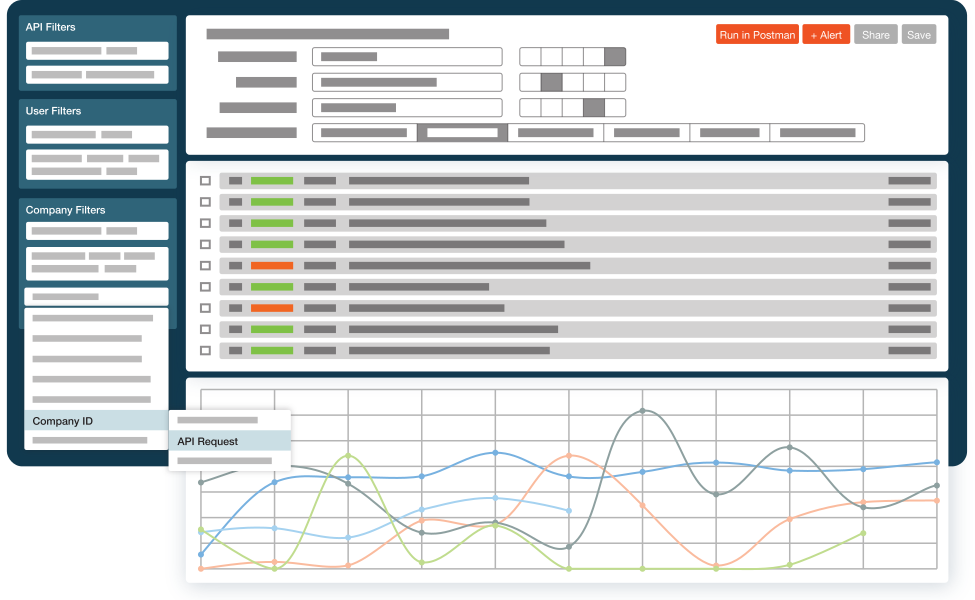
Moesif ships SDKs for FastAPI, Flask, Django, and aiohttp; each integrates as middleware. Once installed, Moesif captures per-request, per-customer, per-endpoint analytics: error rates, latency percentiles, customer behavior cohorts, and (for usage-based products) the metering data that feeds billing.
For teams running an API gateway (Kong, AWS API Gateway, Azure APIM, WSO2), Moesif also integrates at the gateway layer so the application code stays unchanged.
Next steps
The Python API ecosystem is more consolidated and more capable than it was a few years ago. FastAPI plus Pydantic plus SQLAlchemy covers most production needs; the surrounding libraries (auth, caching, rate limiting, observability) are mature and well-documented.
To see per-customer, per-endpoint analytics on the Python API you ship, start a 14-day Moesif free trial. No credit card required.
Frequently asked questions
What is the best Python framework for REST APIs in 2026? FastAPI for new projects. Django REST Framework when you are already on Django. Flask for small services or prototypes.
Is FastAPI better than Flask? For new async REST APIs, generally yes. FastAPI is async-native, type-safe, and auto-generates OpenAPI docs. Flask is still excellent for small synchronous APIs and prototypes.
What about Python GraphQL? Strawberry is the default for new projects. Graphene and Ariadne are reasonable for existing codebases or specific use cases.
Where should I deploy a Python API? Managed platforms (Render, Railway, Fly) for small-to-medium APIs; containers on Cloud Run, App Runner, or Container Apps for scale; Kubernetes if you already operate a cluster.
Do I need an ORM? For any non-trivial API with persistent data, yes. SQLAlchemy 2.0+ is the safe default; SQLModel and Tortoise are reasonable async-native alternatives.
How do I monitor a Python API in production? Pair structured logging and tracing (OpenTelemetry) with per-customer API analytics (Moesif). Application metrics tell you the system is healthy; API analytics tell you the product is working.